

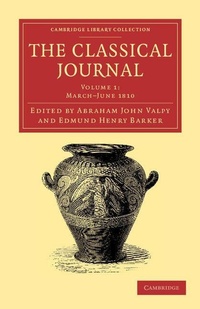
The Classical Journal
Published on 28. February 2013
Book
Paperback/Softback
416 pages
978-1-108-05782-0 (ISBN)
Description
A precursor of modern academic journals, this quarterly periodical, published between 1810 and 1829 and now reissued in forty volumes, was founded and edited by Abraham John Valpy (1787-1854). Educated at Pembroke College, Oxford, Valpy established himself in London as an editor and publisher, primarily of classical texts. Edmund Henry Barker (1788-1839), who had studied at Trinity College, Cambridge, became a contributor and then co-editor of this journal, which fuelled a scholarly feud with the editors of the Museum criticum (1813-26), a rival periodical (also reissued in the Cambridge Library Collection). Although its coverage overlapped with that of its competitor, the Classical Journal also included general literary and antiquarian articles as well as Oxford and Cambridge prize poems and examination papers. It remains a valuable resource, illuminating the development of nineteenth-century classical scholarship and academic journals. Volume 1 contains the March and June issues for 1810.
More details
Series
Language
English
Place of publication
Cambridge
United Kingdom
Target group
College/higher education
Professional and scholarly
Product notice
Paperback (trade)
Illustrations
Worked examples or Exercises
Dimensions
Height: 216 mm
Width: 140 mm
Thickness: 24 mm
Weight
584 gr
ISBN-13
978-1-108-05782-0 (9781108057820)
Copyright in bibliographic data and cover images is held by Nielsen Book Services Limited or by the publishers or by their respective licensors: all rights reserved.
Schweitzer Classification
Other editions
Complete work / Part of the work
Abraham John Valpy | Edmund Henry Barker
The Classical Journal 40 Volume Set
Book
02/2013
Cambridge University Press
€1,903.21
Article is exhausted, reprint undefined
Content
Part I. Desiderium Porsoni; Lusitania liberata; 'Arche hemisu pantos'; Strenua inertia; Prologus ad Phormionem; Epilogus ad Phormionem; Critical notice of Butler's Aeschylus; Of the origin and progress of language and writing; Hager on the numismatical history of the Chinese, and their intercourse with the Greeks; Remarks on a manuscript of Aeschylus's tragedy, The Persians; Hammer's Ancient alphabet, and hieroglyphics; On the emerald; Ancient Arabian poem; On the quantity of a final short vowel before a word beginning with 's' followed by a consonant; In obitum Ricardi Porsoni; Latin inscription; The inscription at Axum; Inscription at Damietta; The Delian inscription; I Corinthians, Chap. XI. ver. 10; Recherches critiques sur la langue de l'Egypte; Vindication of St Paul from the charge of wishing himself accursed; De inscriptione Graeca in insula Chio reperta; Hannae Morae; An Oxford prize poem; Antiquum fragmentum Ovidii Heroides; Critical notice of Burges's Phoenissae of Euripides; Fragments of Sappho; Classical necrology; Biblical criticism; De graecorum verbis ex regula flectendis; Greek verses to Mr Elliot; Inscription at Sens; Critical notice of Miss Smith's Book of Job; Bibliography; Works preparing for the press; Notes to correspondents; Part II. Hager's Chinese Pantheon; Motives to the study of Hebrew; On the royal title of 'Rex Britanniarum'; Calpe obsessa; Elegeia scripta de ponto ad amicum Cantabrigiensem; De la formation du langage; A notice of travels in Asiatic Turkey and Persia; Critical notice of Essays on the Sources of Pleasure Received from Literary Compositions; In villam perelegantem R- H-; On the Latinisation of names; Corinthians I. Chap. II. ver. 10; Critical notices of 'Lindley Murray examined', and 'The essentials of English grammar'; Quo quisque valet suspectos terreat; Notulae to Burges's Phoenissae; Epigramma; Of the standard of taste (1); Of the standard of taste (2); Epigramma; Ad Bruntonam e Granta exituram hendecasyllabi; On the quantity of a final short vowel before a word beginning with 's' followed by a consonant; Biblical criticism; 'mille pericula saevae urbis'; On anticipations of futurity in epic poetry; Critical notice of Burges's editions of the Phoenissae and Troades; Biblical criticism; On the emerald; Inscription on a helmet and cauldron found in the Alpheus, near Olympia; Notae in Philocteten Sophocleum; Of the Greek accents; Critical notice of Miss Smith's Book of Job; Bibliography; Works preparing for the press; Notes to correspondents.