

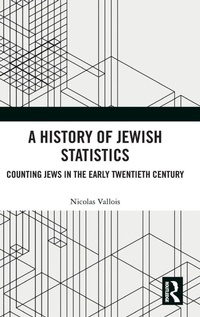
A History of Jewish Statistics
Counting Jews in the Early Twentieth Century
1st Edition
Will be published approx. on 2. July 2026
Book
Hardback
222 pages
978-1-041-11275-4 (ISBN)
Description
From the beginning of the twentieth century, leaders of the nascent Zionist movement saw statistics as a lever for building a Jewish state. More generally, other Jewish intellectuals, Zionists and non-Zionists alike, took part in the development of "Jewish statistics" or "Jewish social sciences," expressions designating all statistical studies and surveys carried out on Jewish populations.
This book traces the social and economic history of this field of research up to the outbreak of the Second World War, analysing not only its institutionalization and gradual structuring but also its practical and theoretical objectives. Against the backdrop of rising antisemitism, Jewish statistics were intended to alert world public opinion, both Jewish and non-Jewish, and to coordinate the actions of the major Jewish relief organizations, especially between the wars. Such efforts did not exclude an academic ambition: like the German social sciences of the time, whose methods and organization they adopted, specialists in Jewish statistics sought to combine social reform and the social sciences and attempted to establish the field as an academic discipline in its own right, dedicated to the study of the material and social conditions of the Jews.
This book will be of interest to readers in the history of economics and statistics and, more broadly, in Jewish history, Jewish studies and the political history of minorities in the modern era.
This book traces the social and economic history of this field of research up to the outbreak of the Second World War, analysing not only its institutionalization and gradual structuring but also its practical and theoretical objectives. Against the backdrop of rising antisemitism, Jewish statistics were intended to alert world public opinion, both Jewish and non-Jewish, and to coordinate the actions of the major Jewish relief organizations, especially between the wars. Such efforts did not exclude an academic ambition: like the German social sciences of the time, whose methods and organization they adopted, specialists in Jewish statistics sought to combine social reform and the social sciences and attempted to establish the field as an academic discipline in its own right, dedicated to the study of the material and social conditions of the Jews.
This book will be of interest to readers in the history of economics and statistics and, more broadly, in Jewish history, Jewish studies and the political history of minorities in the modern era.
More details
Language
English
Place of publication
London
United Kingdom
Publishing group
Taylor & Francis Ltd
Target group
College/higher education
Professional and scholarly
Academic and Postgraduate
Illustrations
3 s/w Photographien bzw. Rasterbilder, 8 s/w Tabellen, 3 s/w Abbildungen
8 Tables, black and white; 3 Halftones, black and white; 3 Illustrations, black and white
Dimensions
Height: 234 mm
Width: 156 mm
ISBN-13
978-1-041-11275-4 (9781041112754)
Copyright in bibliographic data and cover images is held by Nielsen Book Services Limited or by the publishers or by their respective licensors: all rights reserved.
Schweitzer Classification
Other editions
Additional editions
E-Book
approx. 07/2026
Routledge
€60.49
Available for download
E-Book
approx. 07/2026
Routledge
€60.49
Available for download
Person
Nicolas Vallois is Associate Professor of Economics and Social Sciences at the University of Picardie Jules Verne in France.
Content
Introduction Part 1. Institutional Foundations Chapter 1. From Statistics to Statistical Data: The Rise of Quantified Knowledge on Jews in the Nineteenth Century Chapter 2. The Zionist impulse Chapter 3. From Berlin to Warsaw Chapter 4. Politics and Scholarship at the YIVO Economic-Statistical Section Part 2. Theoretical Foundations Chapter 5: Methods of Jewish statistics and main themes Chapter 6. Economics and criminality (1). A contextual approach Chapter 7. Economics and criminality (2). Essentializing the Jews Chapter 8. Epilogue: Language, Diffusion and Legacy