

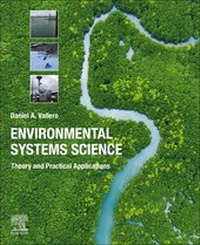
Environmental Systems Science
Theory and Practical Applications
Published on 26. May 2021
Book
Paperback/Softback
704 pages
978-0-12-821953-9 (ISBN)
Description
Environmental Systems Science: Theory and Practical Applications looks at pollution and environmental quality from a systems perspective. Credible human and ecological risk estimation and prediction methods are described, including life cycle assessment, feasibility studies, pollution control decision tools, and approaches to determine adverse outcome pathways, fate and transport, sampling and analysis, and cost-effectiveness. The book brings translational science to environmental quality, applying groundbreaking methodologies like informatics, data mining, and applications of secondary data systems. Multiple human and ecological variables are introduced and integrated to support calculations that aid environmental and public health decision making.
The book bridges the perspectives of scientists, engineers, and other professionals working in numerous environmental and public health fields addressing problems like toxic substances, deforestation, climate change, and loss of biological diversity, recommending sustainable solutions to these and other seemingly intractable environmental problems. The causal agents discussed include physical, chemical, and biological agents, such as per- and polyfluoroalkyl substances (PFAS), SARS-CoV-2 (the COVID-19 virus), and other emerging contaminants.
The book bridges the perspectives of scientists, engineers, and other professionals working in numerous environmental and public health fields addressing problems like toxic substances, deforestation, climate change, and loss of biological diversity, recommending sustainable solutions to these and other seemingly intractable environmental problems. The causal agents discussed include physical, chemical, and biological agents, such as per- and polyfluoroalkyl substances (PFAS), SARS-CoV-2 (the COVID-19 virus), and other emerging contaminants.
Reviews / Votes
"While this book is a fresh entry, it joins multiple volumes devoted to air pollution, all written by the author of this book. The book is succinct, comprehensive, and compelling and I expect it will be broadly adopted for classroom use and as an essential reference. " -- (c) Doody's Review Service, John T. Pierce, MBBS(MD) PhD, reviewer, expert opinionMore details
Language
English
Place of publication
United States
Target group
Professional and scholarly
Researchers and professionals working on air quality or climate change in the atmospheric sciences, engineering, chemistry, environmental sciences and data science
Researchers, professionals and interested readers from numerous other fields, especially biomedicine, urban planning, architecture, construction, pharmaceuticals and consumer product manufacturers and users
Illustrations
Approx. 300 illustrations (150 in full color)
Dimensions
Height: 235 mm
Width: 191 mm
Weight
1360 gr
ISBN-13
978-0-12-821953-9 (9780128219539)
Copyright in bibliographic data and cover images is held by Nielsen Book Services Limited or by the publishers or by their respective licensors: all rights reserved.
Schweitzer Classification
Other editions
Additional editions
E-Book
05/2021
Elsevier
€131.00
Available for download
Person
Professor Daniel A. Vallero is a renowned environmental scientist and engineer with four decades of experience. He has advised U.S. government agencies on critical issues like PBTs, climate change, acid rain, and chemical risks. At Duke University, he led the Engineering Ethics program and taught courses on air pollution, sustainable design, and ethics. Vallero has served on the National Academy of Engineering's Online Ethics Committee and the National Institute of Engineering Ethics. An expert in emerging technologies, he focuses on societal, ethical, and public health challenges related to nanotechnology and environmental biotechnology. His work also encompasses emergency response and homeland security, making him a leading voice in environmental risk and ethics.
Content
1. Systems Science2. The Importance of Scale3. Transitional and Translational Sciences4. Dynamics5. Tools - critical path analysis, root cause analysis, multi-criteria decision analysis, PERT, GANTT6. Equilibrium7. Clean Air Economics8. Cases9. Sustainability vs Risk Analysis10. Land Use Planning11. Future Opportunities and Problems