

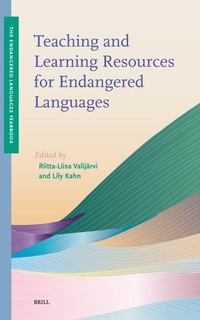
Teaching and Learning Resources for Endangered Languages
Published on 18. May 2023
Book
Hardback
398 pages
978-90-04-53969-3 (ISBN)
Description
The development of teaching and learning materials is an essential component of endangered language revitalisation, yet there is very little academic research on this crucial topic. Our volume seeks to address this imbalance by examining endangered language pedagogical materials from around the world including traditional resources such as grammars, dictionaries, and textbooks, as well as new media such as online courses, apps, video games, etc. Chapters provide theoretical and applied perspectives, and consider Indigenous and other threatened languages from various regions of the world including the Americas, Australia, Europe, the Indian subcontinent, and Southeast Asia. This volume is the first in the FEL Yearbook Series.
More details
Series
Language
English
Place of publication
Leiden
Netherlands
Target group
Professional and scholarly
Product notice
sewn/stitched
Cloth over boards
Dimensions
Height: 234 mm
Width: 155 mm
Thickness: 22 mm
Weight
730 gr
ISBN-13
978-90-04-53969-3 (9789004539693)
Copyright in bibliographic data and cover images is held by Nielsen Book Services Limited or by the publishers or by their respective licensors: all rights reserved.
Schweitzer Classification
Persons
Riitta-Liisa Valijaervi, Ph.D. (2007), Uppsala University, is Associate Professor of Finnish and Minority Languages at University College London, and Senior Lecturer in Finnish at Uppsala University, Sweden. With Lily Kahn she recently published West Greenlandic: An Essential Grammar (Routledge, 2022).
Lily Kahn, Ph.D. (2008), University College London, is Head of the Department of Hebrew and Jewish Studies at that university. She is co-editor of the UCL Press series Grammars of World and Minority Languages and Textbooks of World and Minority Languages with Riitta-Liisa Valijaervi.
Lily Kahn, Ph.D. (2008), University College London, is Head of the Department of Hebrew and Jewish Studies at that university. She is co-editor of the UCL Press series Grammars of World and Minority Languages and Textbooks of World and Minority Languages with Riitta-Liisa Valijaervi.
Content
List of Figures
List of Tables
List of Maps
Notes on Contributors
Introduction
?Riitta-Liisa Valijaervi and Lily Kahn
Part 1 Innovative Teaching and Learning Materials
1 Resourcing an Awakening Language: Kaurna of the Adelaide Plains, South Australia
?Rob Amery, Mary-Anne Gale, and Susie Greenwood
2 Activating Resources for Teaching and Learning an Indigenous Australian Language Online: The Case of Bininj Kunwok
?Catherine Bow
3 Contributions of the Mercator Centre and the Foundation for Siberian Cultures to Educational Materials for Endangered Languages: The Case of Itelmen
?Tjeerd de Graaf and Erich Kasten
4 Experiences in Teaching an Endangered Language: Finding the Motivation and Means to Ensure the Acquisition of Livonian
?Valts Ernstreits and Gunta Klava
Part 2 Educational Contexts for Teaching and Learning Materials
5 Not Enough Words: Language Acquisition and Identity Work in Tertiary-Level Gaelic-Medium Education
?Timothy Currie Armstrong
6 Empowering Teachers and Students: Torwali Education Practices and Learning Materials
?Mujahid Torwali and Jakelin Troy
7 Mother Tongue Education with Indigenous Trainee Teachers: The Acai Project
?Vera da Silva Sinha and Wany Bernardete de Araujo Sampaio
8 Exploring the Uses of Multilingual Dictionaries among the Safaliba in Ghana and the Gorontalo in Indonesia
?Colleen Alena O'Brien and Ari Sherris
Part 3 Ideological Issues regarding Teaching and Learning Materials
9 'It's Our Turn Now': The Tehuelches' Own Artefactualisation of Their Language
?Javier Domingo
10 'We Didn't Wear Skirts': Extralinguistic Factors in the Development of Wayoro Pedagogical Materials
?Antonia Fernanda de Souza Nogueira, Gilson Wajuru Massaka, and Adao Wajuru
11 Ukrainian Language Revitalization Online: Targeting Ukraine's Russian Speakers
?Natalia Kudriavtseva
Part 4 Teaching and Learning Methods for Endangered Languages
12 Can We Apply 'Large Languages' Teaching Methods to the Teaching of Endangered Languages?
?Meili Fang and David Nathan
13 The Revitalization of Tobati, an Endangered Language of Papua in Indonesia
?Satwiko Budiono
14 The Media-Based Syllabus for Adult Minority Language Learning
?Tobias Weber
Part 5 Orthography Development for Endangered Language Pedagogy
15 Writing for the Future: An Orthography for Heritage and New Speakers of a Critically Endangered Language
?Jhonnatan Rangel
16 Changing Attitudes, Orthographic Variation, and the Creation of Pedagogical and Literacy Materials for Endangered Languages: The Case of Blanga, Solomon Islands
?Radu Voica
17 Using Children's Native Language Repertoire to Develop Literacy Materials: Early Writing in Torwali
?Zubair Torwali
18 Developing Materials for Endangered Indigenous Scripts in the Philippines: Lessons from Mindoro
?Louward Allen Zubiri, Anya Postma, Uyan Daay, Johnny Solina, Dindo Agan, Pinoy Tugas, Christopher Baylan, and Emerenciana Catapang
Index
List of Tables
List of Maps
Notes on Contributors
Introduction
?Riitta-Liisa Valijaervi and Lily Kahn
Part 1 Innovative Teaching and Learning Materials
1 Resourcing an Awakening Language: Kaurna of the Adelaide Plains, South Australia
?Rob Amery, Mary-Anne Gale, and Susie Greenwood
2 Activating Resources for Teaching and Learning an Indigenous Australian Language Online: The Case of Bininj Kunwok
?Catherine Bow
3 Contributions of the Mercator Centre and the Foundation for Siberian Cultures to Educational Materials for Endangered Languages: The Case of Itelmen
?Tjeerd de Graaf and Erich Kasten
4 Experiences in Teaching an Endangered Language: Finding the Motivation and Means to Ensure the Acquisition of Livonian
?Valts Ernstreits and Gunta Klava
Part 2 Educational Contexts for Teaching and Learning Materials
5 Not Enough Words: Language Acquisition and Identity Work in Tertiary-Level Gaelic-Medium Education
?Timothy Currie Armstrong
6 Empowering Teachers and Students: Torwali Education Practices and Learning Materials
?Mujahid Torwali and Jakelin Troy
7 Mother Tongue Education with Indigenous Trainee Teachers: The Acai Project
?Vera da Silva Sinha and Wany Bernardete de Araujo Sampaio
8 Exploring the Uses of Multilingual Dictionaries among the Safaliba in Ghana and the Gorontalo in Indonesia
?Colleen Alena O'Brien and Ari Sherris
Part 3 Ideological Issues regarding Teaching and Learning Materials
9 'It's Our Turn Now': The Tehuelches' Own Artefactualisation of Their Language
?Javier Domingo
10 'We Didn't Wear Skirts': Extralinguistic Factors in the Development of Wayoro Pedagogical Materials
?Antonia Fernanda de Souza Nogueira, Gilson Wajuru Massaka, and Adao Wajuru
11 Ukrainian Language Revitalization Online: Targeting Ukraine's Russian Speakers
?Natalia Kudriavtseva
Part 4 Teaching and Learning Methods for Endangered Languages
12 Can We Apply 'Large Languages' Teaching Methods to the Teaching of Endangered Languages?
?Meili Fang and David Nathan
13 The Revitalization of Tobati, an Endangered Language of Papua in Indonesia
?Satwiko Budiono
14 The Media-Based Syllabus for Adult Minority Language Learning
?Tobias Weber
Part 5 Orthography Development for Endangered Language Pedagogy
15 Writing for the Future: An Orthography for Heritage and New Speakers of a Critically Endangered Language
?Jhonnatan Rangel
16 Changing Attitudes, Orthographic Variation, and the Creation of Pedagogical and Literacy Materials for Endangered Languages: The Case of Blanga, Solomon Islands
?Radu Voica
17 Using Children's Native Language Repertoire to Develop Literacy Materials: Early Writing in Torwali
?Zubair Torwali
18 Developing Materials for Endangered Indigenous Scripts in the Philippines: Lessons from Mindoro
?Louward Allen Zubiri, Anya Postma, Uyan Daay, Johnny Solina, Dindo Agan, Pinoy Tugas, Christopher Baylan, and Emerenciana Catapang
Index