

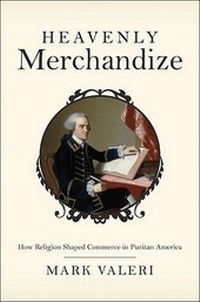
Heavenly Merchandize
How Religion Shaped Commerce in Puritan America
Published on 21. July 2010
Book
Hardback
360 pages
978-0-691-14359-0 (ISBN)
Description
Heavenly Merchandize offers a critical reexamination of religion's role in the creation of a market economy in early America. Focusing on the economic culture of New England, it views commerce through the eyes of four generations of Boston merchants, drawing upon their personal letters, diaries, business records, and sermon notes to reveal how merchants built a modern form of exchange out of profound transitions in the puritan understanding of discipline, providence, and the meaning of New England. Mark Valeri traces the careers of men like Robert Keayne, a London immigrant punished by his church for aggressive business practices; John Hull, a silversmith-turned-trader who helped to establish commercial networks in the West Indies; and Hugh Hall, one of New England's first slave traders. He explores how Boston ministers reconstituted their moral languages over the course of a century, from a scriptural discourse against many market practices to a providential worldview that justified England's commercial hegemony and legitimated the market as a divine construct.
Valeri moves beyond simplistic readings that reduce commercial activity to secular mind-sets, and refutes the popular notion of an inherent affinity between puritanism and capitalism. He shows how changing ideas about what it meant to be pious and puritan informed the business practices of Boston's merchants, who filled their private notebooks with meditations on scripture and the natural order, founded and led churches, and inscribed spiritual reflections in their letters and diaries. Unprecedented in scope and rich with insights, Heavenly Merchandize illuminates the history behind the continuing American dilemma over morality and the marketplace.
Valeri moves beyond simplistic readings that reduce commercial activity to secular mind-sets, and refutes the popular notion of an inherent affinity between puritanism and capitalism. He shows how changing ideas about what it meant to be pious and puritan informed the business practices of Boston's merchants, who filled their private notebooks with meditations on scripture and the natural order, founded and led churches, and inscribed spiritual reflections in their letters and diaries. Unprecedented in scope and rich with insights, Heavenly Merchandize illuminates the history behind the continuing American dilemma over morality and the marketplace.
Reviews / Votes
Winner of the 2011 Philip Schaff Prize, American Society of Church History Shortlisted for the 2011 American Academy of Religion Award for Excellence in the Historical Study of Religion One of Choice's Outstanding Academic Titles for 2010 "Valeri's reading of theological sources is so satisfying because he is a subtle, careful reader; he resists the temptation to smooth away contradictions, or to oversimplify; indeed, he seems allergic to polemic it is thus not surprising when, at the end of the book--just when the author might be expected to tip his hand about what all this market accommodation means--Valeri is maddeningly even-handed."--Lauren F. Winner, Books & Culture "I found this book to be an outstanding contribution to our understanding of the working out of the Protestant ethic in colonial New England. Therefore, it is a major contribution to our understanding of American economic morality."--Donald E. Frey, EH.Net "Students of early New England will find this indispensable; it should also appeal to anyone interested in the relationship between religion and the larger culture."--Choice "[T]he effectiveness with which Valeri utilizes the small-scale cultural world of Puritan Massachusetts in the colonial era in order to examine developments that have wider ramifications, indicates that, as with Perry Miller and so many others, that time and place is still a fruitful laboratory for thick analysis of religiocultural change."--Dewey D. Wallace, Jr., Interpretation "Valeri's well-written case studies bring many rewards to the reader. They forcefully demonstrate that no one can understand the changing culture of early America without paying attention to religion."--R. Laurence Moore, Journal of Church History "The book is noteworthy as much for its method as for its conclusions. Valeri's inferences rise convincingly from his methodology, analysis, and rhetoric... [H]andled artfully in an elegant narrative."--Barry Levy, American Historical Review "This book will certainly change the way both Puritan theology and economics are viewed and is highly recommended."--Suzanne Geissler, Anglican and Episcopal History "An important study... [T]his stellar work breaks important new ground on the complex drama of economics and religion in early modern America."--Robert E. Brown, Religious Studies ReviewMore details
Language
English
Place of publication
New Jersey
United States
Target group
College/higher education
Professional and scholarly
Product notice
Trade binding
Illustrations
16 halftones.
Dimensions
Height: 229 mm
Width: 152 mm
Weight
652 gr
ISBN-13
978-0-691-14359-0 (9780691143590)
Copyright in bibliographic data and cover images is held by Nielsen Book Services Limited or by the publishers or by their respective licensors: all rights reserved.
Schweitzer Classification
Other editions
Additional editions
E-Book
06/2015
1st Edition
Princeton University Press
from
€116.95
Available for download
Person
Mark Valeri is the Ernest Trice Thompson Professor of Church History at the Union Theological Seminary and Presbyterian School of Christian Education in Virginia. His books include "Law and Providence in Joseph Bellamy's New England: The Origins of the New Divinity in Revolutionary America and The Works of Jonathan Edwards, Volume 17: Sermons and Discourses, 1730-1733".
Content
List of Illustrations ix Preface xi INTRODUCTION: Heavenly Merchandize 1 CHAPTER ONE: Robert Keayne's Gift 11 Keayne, the Merchant Taylors' Company, and Civic Humanism 14 Keayne and the Godly Community in England 26 CHAPTER TWO: Robert Keayne's Trials 37 Boston's First Merchants 39 Puritan Discipline in England 50 Discipline and Trade in Early Boston 57 CHAPTER THREE: John Hull's Accounts 74 Hull and the Expansion of New England's Market 76 Hull's Piety and Changes in Church Discipline 83 Jeremiads, Providence, and New England's Civic Order 96 CHAPTER FOUR: Samuel Sewall's Windows 111 Sewall's and Fitch's Problems with Money 114 The Politics of Empire 122 Political Economy, Monetary Policy, and the Justification of Usury 134 Merchants' Callings and the Campaign for Moral Reform 157 Religious Conviction in the Affairs of Sewall and Fitch 168 CHAPTER FIVE: Hugh Hall's Scheme 178 Hall and Boston's Provincial Merchants 181 Rational Protestantism and the Meaning of Commerce 200 Gentility, the Empire, and Piety in the Affairs of Hall 220 EPILOGUE: Religious Revival 234 Samuel Philips Savage, Isaac Smith, and Robert Treat Paine 235 Social Virtue and the Market 240 Conclusion 248 Notes 251 Index 321