

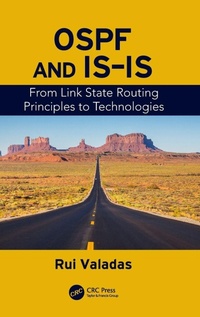
OSPF and IS-IS
From Link State Routing Principles to Technologies
1st Edition
Published on 2. January 2019
Book
Hardback
426 pages
978-1-138-50455-4 (ISBN)
Description
This book describes and compares both the IPv4 and IPv6 versions of OSPF and IS-IS. It explains OSPF and IS-IS by grounding the analysis on the principles of Link State Routing (LSR). It deliberately separates principles from technologies. Understanding the principles behind the technologies makes the learning process easier and more solid. Moreover, it helps uncovering the dissimilarities and commonalities of OSPF and IS-IS and exposing their stronger and weaker features. The chapters on principles explain the features of LSR protocols and discuss the alternative design options, independently of technologies. The chapters on technologies provide a comprehensive description of OSPF and IS-IS with enough detail for professionals that need to work with these technologies. The final part of the book describes and discusses a large set of experiments with Cisco routers designed to illustrate the various features of OSPF and IS-IS. In particular, the experiments related to the synchronization mechanisms are not usually found in the literature.
More details
Language
English
Place of publication
London
United Kingdom
Publishing group
Taylor & Francis Ltd
Target group
Professional and scholarly
Academic and Professional Practice & Development
Dimensions
Height: 240 mm
Width: 161 mm
Thickness: 27 mm
Weight
804 gr
ISBN-13
978-1-138-50455-4 (9781138504554)
Copyright in bibliographic data and cover images is held by Nielsen Book Services Limited or by the publishers or by their respective licensors: all rights reserved.
Schweitzer Classification
Other editions
Additional editions
Book
09/2020
1st Edition
CRC Press
€70.70
Shipment within 15-20 days
E-Book
01/2019
CRC Press
€63.49
Available for download
E-Book
01/2019
1st Edition
CRC Press
€63.49
Available for download
Person
Rui Valadas is a Full Professor at Instituto Superior Tecnico, Universidade de Lisboa, Portugal, and a senior researcher of Instituto de Telecomunicacoes, Portugal. He was previously at the University of Aveiro, Portugal. He has had a regular teaching activity since 1986 and has been responsible for more than 20 University courses, at the various levels, BSc, MSc, and PhD, mainly in the area of Computer Networking. He set up, at both the University of Aveiro and Instituto Superior Tecnico, laboratory infrastructures for teaching Computer Networks. He also created Cisco Academies at both Universities and is a CCNA instructor. He organized several courses targeted to industry with a laboratory component, namely a practical course on basic TCP/IP networking and a practical course on TCP/IP networking security. He has reasoned for long on the teaching methodologies of Computer Networking and published several papers on the subject. Among other management duties, he was the first director of the PhD course in Telecommunications jointly organized by the Universities of Minho, Aveiro, and Porto, in Portugal, and he coordinates since 2009 the BSc/MSc on Telecommunications and Informatics Engineering of Instituto Superior Tecnico. His scientific activity concentrated on two main areas: Wireless Optical Communications (in the past) and Computer Networking, with an emphasis in Routing and Traffic Engineering aspects (currently). He supervised more than 30 PhD thesis and MSc dissertations. He played an active role is the specification of the IEEE 802.11 standard, being the author of 20 contributions to this standard. He participated in 25 research projects, both national and European, most of them as the responsible investigator. He is the author of 4 book chapters, and more than 100 papers in international journals and conferences. His papers deserved more than 2000 citations and an h-index of 22, according to Google Scholar.
Content
Part 1: Introduction. Routing and Addressing. Part 2: Principles. 2. Principles of Single-Area Link State Routing. 3. Principles of Multi-Area Link State Routing. Part 3: Technologies. 4. Overview of OSPF and IS-IS. 5. LSDB Structure of OSPF and IS-IS Single-Area Networks. 6. OSPF and IS-IS Synchronization Mechanisms. 7. OSPF and IS-IS Hierarchical Networks. Part 4: Case Studies. 8. Tools and Configurations. 9. Experiments on Forwarding Tables and LSDB. 10. Experiments on Synchronization Mechanisms. 11. Experiments on Hierarchical Networks.