

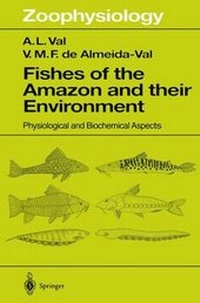
Fishes of the Amazon and Their Environment
Physiological and Biochemical Aspects
Published on 20. June 1995
Book
Hardback
XI, 224 pages
978-3-540-58382-0 (ISBN)
Description
The Amazon is a giant piece of "amphibian" land which is the result of complex geological and evolutionary processes. The number of living beings in such a land is difficult to estimate. The interactions between these organ isms and the environment are fascinating but barely understood. These features lured us to the Amazon in 1981. However, soon after, we realized that the dimensions of these interactions were overwhelming. This book is designed to review aspects of the physiology and biochemistry of fishes of the Amazon. The description of the pulsative nature of the environment and the distinct features of the ichthyofauna of the Amazon were central to the main goal. Nevertheless, any complete view is limited by the magnitude of the intraspecific variability coupled with the complex fluctuations of the environment. Thus, we have placed an emphasis on respiratory physiology and biochemistry. The reference list was made as complete as possible, particularly regarding special publications not readily available. We hope that this book is useful for comparative physiologists, tropical biologists, and the people interested in interactions between organ isms and their environment. We are grateful to many people who contributed to the making of this book. Our initial ideas were influenced by Drs. Arno Schwantes, Maria Lufza Schwantes, Jose Tundisi, Anna Emflia Vazzoler, and Naercio Menezes.
More details
Series
Language
English
Place of publication
Heidelberg
Germany
Publishing group
Springer Berlin
Target group
College/higher education
Professional and scholarly
Illustrations
biography
Dimensions
Height: 23.5 cm
Width: 15.5 cm
Weight
480 gr
ISBN-13
978-3-540-58382-0 (9783540583820)
DOI
10.1007/978-3-642-79229-8
Schweitzer Classification
Other editions
Additional editions
A.L. Val | V.M.F.de Almeida-Val
Fishes of the Amazon and Their Environment
Physiological and Biochemical Aspects
Book
12/2011
Springer
€106.99
Shipment within 7-9 days
Content
1. Introduction.- 2. Amazonian Waters.- 2.1 Geological Aspects of the Basin.- 2.2 Dimensions of the Region.- 2.3 Climate.- 2.3.1 Climate in the Past and in the Future.- 2.3.2 Precipitation.- 2.3.3 Solar Radiation.- 2.3.4 Temperature.- 2.4 The Amazon Basin.- 2.4.1 Division of the Amazon Basin.- 2.4.2 Basin Connections.- 2.4.3 Types of Water.- 2.4.4 Chemical and Physical Characteristics of Amazon Waters.- 2.4.5 The Main Rivers.- 2.4.6 Várzea and Igapó.- 2.4.7 Lakes.- 2.4.8 Annual Flood Cycle.- 2.4.9 Metabolism in Amazon Waters.- 2.5 Recent Modifications Produced by the Activities of Man.- 2.5.1 Fish Culture in the Amazon.- 3. The Amazon Ichthyofauna.- 3.1 Ichthyofauna Composition.- 3.1.1 The Elasmobranchii.- 3.1.2 The Dipneusti.- 3.1.3 The Teleostei.- 3.1.3.1 Osteoglossiformes and Clupeiformes.- 3.1.3.2 Ostariophysi.- 3.1.3.3 Paracanthopterygii and Acanthopterygii.- 3.2 Feeding Behaviour.- 3.2.1 What Do the Amazonian Fish Eat?.- 3.2.2 When and How Much Is Eaten?.- 3.3 Migratory Cycles.- 3.4 Breeding Patterns.- 3.4.1 Larval Development.- 3.5 Communication.- 3.6 Evolutionary and Genetic Features.- 3.6.1 Karyotypes of Fishes of the Amazon.- 3.6.2 Isozymes.- 3.6.2.1 Lactate Dehydrogenase.- 3.6.2.2 Malate Dehydrogenase.- 3.6.3 Allozymes.- 3.6.4 Other Proteins.- 4. Gas Exchange.- 4.1 The Obligatory Air-Breathers.- 4.1.1 The Lungfish Lepidosiren paradoxa.- 4.1.2 Arapaima gigas.- 4.1.3 Electrophorus electricus.- 4.1.4 Controversial Points.- 4.2 The Facultative Air-Breathers.- 4.2.1 Gills as Air-Breathing Organs.- 4.2.2 The Stomach and Intestine as Air-Breathing Organs.- 4.2.3 Swim Bladder as an Accessory Air-Breathing Organ.- 4.3 Water-Breathing.- 4.3.1 Avoiding Low Oxygen Conditions.- 4.3.2 Skimming the Water's Surface.- 4.3.3 Improving Oxygen Transfer.- 4.4 The Blood.- 4.4.1 The Erythrocytes.- 4.4.2 The Hemoglobins.- 4.4.2.1 Blood Levels and Solubility of Hemoglobins.- 4.4.2.2 Adjustments of Hemoglobin Proportions.- 4.4.2.3 Why So Many Hemoglobin Fractions?.- 4.4.2.4 Methemoglobin Levels.- 4.4.3 Oxygen Affinity of Hemoglobins.- 4.4.3.1 Effect of Temperature on Hb-O2 Affinity.- 4.4.3.2 The Effect of Phosphates on Hb-O2 Affinity.- 4.4.4 Oxygen Affinity of Blood.- 4.4.5 The Root Effect.- 4.4.6 Intraerythrocytic Phosphates.- 4.4.6.1 Ontogenetic Changes in the Red Blood Cell Organic Phosphate Concentrations.- 4.4.6.2 Effects of Migration on Intraerythrocytic NTP Levels.- 4.4.6.3 Environmental Factors Affecting the Red Blood Cell Organic Phosphate Concentrations.- 4.4.6.4 Interactive Effects.- 4.5 Effects of Specific Environmental Conditions on Gas Transfer.- 5. Respiratory Metabolism.- 5.1 Optimizing Aerobic Metabolism.- 5.1.1 Air-Breathers Versus Water-Breathers.- 5.1.2 Oxygen Consumption.- 5.1.3 Enzyme-Level Adjustments.- 5.1.3.1 LDH Isozymes: Channelling Pyruvate.- 5.1.3.2 Aerobic Versus Anaerobic Pathways.- 5.2 Effects of Hypoxia.- 5.2.1 Metabolites.- 5.2.2 Tissue Metabolic Regulation.- 5.3 Temperature Effects.- 5.3.1 Isozyme Thermostability.- 5.3.2 Km Versus Temperature.- 5.3.3 Temperature and pH: Combined Effects.- 5.3.3.1 Q10.- 5.3.4 Thermal Acclimation.- 5.3.4.1 Electrophoretic Pattern.- 5.3.4.2 Km.- 5.3.4.3 Regulating Q10 Values.- 5.4 Metabolic Arrest.- 5.4.1 Lungfish Estivation.- 5.5 Effects of Specific Environmental Conditions.- 5.5.1 Accumulating End Products.- 5.5.1.1 Lactate Accumulation.- 5.5.2.2 Ammonia Accumulation.- 6. Conclusion and Perspectives.- 6.1 Perspectives.- References.- Systematic Index.