

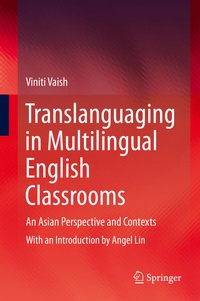
Translanguaging in Multilingual English Classrooms
An Asian Perspective and Contexts
Published on 12. February 2020
Book
Hardback
VII, 130 pages
978-981-15-1086-1 (ISBN)
Description
This book is the first to apply the theory of translanguaging to multilingual classrooms in an Asian context, offering strategies for teaching specific grammatical and comprehension skills to students struggling to read in English. It also enriches the methodology of coding bilingual transcripts with ideas resulting from a detailed analysis of a large and rich data set. Lastly, the author discusses growth areas in the emerging field of translanguaging and challenges for teachers implementing a translanguaging approach in a superdiverse classroom.
More details
Edition
2020 ed.
Language
English
Place of publication
Singapore
Singapore
Target group
Professional and scholarly
Illustrations
23 s/w Abbildungen
VII, 130 p. 23 illus.
Dimensions
Height: 241 mm
Width: 160 mm
Thickness: 14 mm
Weight
383 gr
ISBN-13
978-981-15-1086-1 (9789811510861)
DOI
10.1007/978-981-15-1088-5
Schweitzer Classification
Other editions
Additional editions
E-Book
02/2020
1st Edition
Springer
€106.99
Available for download
Person
Viniti Vaish holds a Ph.D. from the University of Pennsylvania's Graduate School of Education. She is currently an Associate Professor at Singapore's National Institute of Education, Nanyang Technological University, where she teaches courses in Applied Linguistics. Her research interests include the documentation, measurement and enhancement of bilingualism and biliteracy in individuals and communities. Viniti speaks Hindi, Urdu and English, and reads Hindi, English and Sanskrit.
Content
1 The Linguistic Ecology of Singapore.- 2 Methodology 1: Translanguaging and the Classroom.- 3 Methodology 2: Coding Bilingual Transcripts.- 4 Comparing Monolingual and Bilingual Classrooms.- 5 Interactional Patterns in the Malay Group.- 6 Interactional Patterns in the Chinese Group.- 7 The Storytellers: Oral Retelling of Bilingual Children Struggling to Read in English.- 8 Conclusions and Future Directions.