

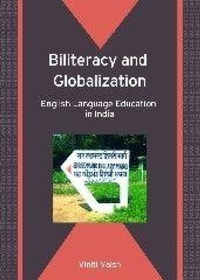
Biliteracy and Globalization
English Language Education in India
Published on 4. February 2008
Book
Paperback/Softback
136 pages
978-1-84769-032-6 (ISBN)
Description
This book analyzes how the urban disadvantaged in the city of New Delhi learn English. Using qualitative methods the author discusses the pedagogy, texts and contexts in which biliteracy occurs and links English language teaching and learning in India with the broader social and economic processes of globalization in a developing country. The study is situated in a government school, a site where classrooms have rarely been qualitatively described, and where the Three Language Formula (TLF) is being fundamentally transformed due to increasing demand from the community for earlier access to the linguistic capital of English. Through research conducted in a call centre the author also shows what the requirements of new workplaces are and how government schools are trying to meet this demand.
Reviews / Votes
This book is recommended reading for language researchers and teachers. -- Janaina Minelli de Oliveira, Universitat Rovira i Virgili, Spain * Discourse and Society 20(4) *More details
Series
Language
English
Place of publication
Bristol
United Kingdom
Publishing group
Channel View Publications Ltd
Target group
College/higher education
Professional and scholarly
Dimensions
Height: 210 mm
Width: 148 mm
Thickness: 8 mm
Weight
189 gr
ISBN-13
978-1-84769-032-6 (9781847690326)
Copyright in bibliographic data and cover images is held by Nielsen Book Services Limited or by the publishers or by their respective licensors: all rights reserved.
Schweitzer Classification
Other editions
Additional editions
Book
02/2008
Multilingual Matters
€141.50
Article exhausted; check different version
E-Book
02/2008
1st Edition
Multilingual Matters
€14.49
Available for download
Person
Viniti Vaish is Assistant Professor at Singaporea??s Centre for Research in Pedagogy and Practice (CRPP), National Institute of Education. She has worked in different capacities in India, the USA and Singapore. Her research interests include bilingual and comparative education, pedagogy and language policy. Currently she is Co-Principal Investigator of a??The Sociolinguistic Survey of Singapore, 2006a??, a large scale language survey linked to smaller scale follow up studies, which is one of the projects undertaken by CRPP. She has published in Language Policy , the International Journal of Bilingual Education and Bilingualism and the International Journal of Multilingualism.
Content
Preface
Introduction
1. English as a Language of Decolonization
2. Biliteracy and Globalization
3. In what Languages is English Taught?
4. What is Taught?
5. In what Contexts is English Taught?
6. How Much is Learned?
7. Conclusion
Bibliography
Appendix 1: Non Scheduled Languages
Appendix 2: 15 day Training Schedule for a Call Centre
Appendix 3: Photos
Introduction
1. English as a Language of Decolonization
2. Biliteracy and Globalization
3. In what Languages is English Taught?
4. What is Taught?
5. In what Contexts is English Taught?
6. How Much is Learned?
7. Conclusion
Bibliography
Appendix 1: Non Scheduled Languages
Appendix 2: 15 day Training Schedule for a Call Centre
Appendix 3: Photos