

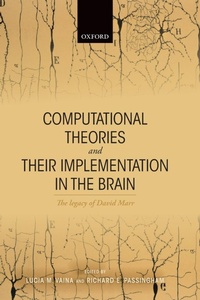
Computational Theories and their Implementation in the Brain
The legacy of David Marr
Published on 3. November 2016
Book
Hardback
272 pages
978-0-19-874978-3 (ISBN)
Description
In the late 1960s and early 1970s David Marr produced three astonishing papers in which he gave a detailed account of how the fine structure and known cell types of the cerebellum, hippocampus and neocortex perform the functions that they do. Marr went on to become one of the main founders of Computational Neuroscience. In his classic work 'Vision' he distinguished between the computational, algorithmic, and implementational levels, and the three early theories concerned implementation. However, they were produced when Neuroscience was in its infancy.
Now that so much more is known, it is timely to revisit these early theories to see to what extent they are still valid and what needs to be altered to produce viable theories that stand up to current evidence.
This book brings together some of the most distinguished scientists in their fields to evaluate Marr's legacy. After a general introduction there are three chapters on the cerebellum, three on the hippocampus and two on the neocortex. The book ends with an appreciation of the life of David Marr by Lucia Vaina.
Now that so much more is known, it is timely to revisit these early theories to see to what extent they are still valid and what needs to be altered to produce viable theories that stand up to current evidence.
This book brings together some of the most distinguished scientists in their fields to evaluate Marr's legacy. After a general introduction there are three chapters on the cerebellum, three on the hippocampus and two on the neocortex. The book ends with an appreciation of the life of David Marr by Lucia Vaina.
More details
Language
English
Place of publication
Oxford
United Kingdom
Target group
College/higher education
Dimensions
Height: 260 mm
Width: 183 mm
Thickness: 19 mm
Weight
716 gr
ISBN-13
978-0-19-874978-3 (9780198749783)
Copyright in bibliographic data and cover images is held by Nielsen Book Services Limited or by the publishers or by their respective licensors: all rights reserved.
Schweitzer Classification
Other editions
Additional editions
Lucia M. Vaina | Richard E. Passingham
Computational Theories and their Implementation in the Brain
The legacy of David Marr
E-Book
10/2016
1st Edition
OUP eBook
€57.99
Available for download
Lucia M. Vaina | Richard E. Passingham
Computational Theories and their Implementation in the Brain
The legacy of David Marr
E-Book
10/2016
1st Edition
OUP eBook
€57.99
Available for download
Persons
Professor Lucia M. Vaina received an MS in mathematics from University of Timisoara and Pavia, PhD in mathematical logic from the Sorbonne and MD PhD (neuroscience) from the University of Toulouse. Her postdoctoral training was at UC Berkeley, Stanford and MIT. She joined the faculty of Boston University and Harvard Medical School in 1986 and in 1995 she was promoted to tenured Professor of Biomedical Engineering at Boston University. She is among the first visual neuroscientists that studied the effects of lesions on visual motion perception in humans, by using psychophysics, biologically constrained computational modeling, and MRI, fMRI and MEG. She characterized the cortical mechanisms underlying visual motion tasks, and alternate mechanisms used by motion impaired patients. She studied psychophysically&computationally aspects of perceptual learning of motion discrimination and used fMRI to elucidate their neural substrate
Professor Richard E. Passingham received his BA from the University of Oxford and his Ph.D in Psychology from the University of London. He returned to Oxford in 1970 and was made a University Lecturer and Fellow of Wadham College in 1976. He was amongst the first to use brain imaging to study human cognition, starting in 1988 at the MRC Cyclotron Unit at the Hammersmith Hospital where he was an Honorary Senior Lecturer. In 1996 he moved to the newly founded Wellcome Centre for NeuroImaging at the University of London where he was an Honorary Principal. He was made Professor of Cognitive Neuroscience at Oxford in 1997.
Professor Richard E. Passingham received his BA from the University of Oxford and his Ph.D in Psychology from the University of London. He returned to Oxford in 1970 and was made a University Lecturer and Fellow of Wadham College in 1976. He was amongst the first to use brain imaging to study human cognition, starting in 1988 at the MRC Cyclotron Unit at the Hammersmith Hospital where he was an Honorary Senior Lecturer. In 1996 he moved to the newly founded Wellcome Centre for NeuroImaging at the University of London where he was an Honorary Principal. He was made Professor of Cognitive Neuroscience at Oxford in 1997.
Editor
Professor of Biomedical Engineering, and co-Director of the Neurology of Vision LaboratoryProfessor of Biomedical Engineering, and co-Director of the Neurology of Vision Laboratory, Neuroscience and Neurology, Boston University; and Massachusetts General Hospital, Harvard Medical School, Boston, MA, USA
Emeritus Professor of Cognitive NeuroscienceEmeritus Professor of Cognitive Neuroscience, Department of Experimental Psychology, Oxford, UK
Content
INTRODUCTION; SECTION 1: A THEORY OF CEREBELLAR CORTEX; SECTION 2: SIMPLE MEMORY: A THEORY FOR ARCHICORTEX; SECTION 3: A THEORY OF NEOCORTEX; DAVID MARR