

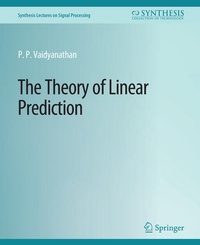
The Theory of Linear Prediction
Published on 31. December 2007
Book
Paperback/Softback
XIV, 183 pages
978-3-031-01399-7 (ISBN)
Description
Linear prediction theory has had a profound impact in the field of digital signal processing. Although the theory dates back to the early 1940s, its influence can still be seen in applications today. The theory is based on very elegant mathematics and leads to many beautiful insights into statistical signal processing. Although prediction is only a part of the more general topics of linear estimation, filtering, and smoothing, this book focuses on linear prediction. This has enabled detailed discussion of a number of issues that are normally not found in texts. For example, the theory of vector linear prediction is explained in considerable detail and so is the theory of line spectral processes. This focus and its small size make the book different from many excellent texts which cover the topic, including a few that are actually dedicated to linear prediction. There are several examples and computer-based demonstrations of the theory. Applications are mentioned wherever appropriate, but the focus is not on the detailed development of these applications. The writing style is meant to be suitable for self-study as well as for classroom use at the senior and first-year graduate levels. The text is self-contained for readers with introductory exposure to signal processing, random processes, and the theory of matrices, and a historical perspective and detailed outline are given in the first chapter.
Table of Contents: Introduction / The Optimal Linear Prediction Problem / Levinson's Recursion / Lattice Structures for Linear Prediction / Autoregressive Modeling / Prediction Error Bound and Spectral Flatness / Line Spectral Processes / Linear Prediction Theory for Vector Processes / Appendix A: Linear Estimation of Random Variables / B: Proof of a Property of Autocorrelations / C: Stability of the Inverse Filter / Recursion Satisfied by AR Autocorrelations
More details
Series
Language
English
Place of publication
Cham
Switzerland
Publishing group
Springer International Publishing
Target group
Professional and scholarly
Illustrations
XIV, 183 p.
Dimensions
Height: 235 mm
Width: 191 mm
Thickness: 12 mm
Weight
384 gr
ISBN-13
978-3-031-01399-7 (9783031013997)
DOI
10.1007/978-3-031-02527-3
Schweitzer Classification
Other editions
Additional editions
P.P. Vaidyanathan
The Theory of Linear Prediction
E-Book
06/2022
Springer
€35.30
Available for download
Person
P. P. Vaidyanathan received his bachelor of science, bachelor of technology, and master of technology degrees from the University of Calcutta, India. He obtained his doctor of philosophy degree from the University of California at Santa Barbara and became a faculty of the Department of Electrical Engineering at the California Institute of Technology in 1983. He served as the executive officer of the Department of ElectricalEngineering at Caltech for the period 2002-2005. He has received several awards for excellence in teaching at Caltech. He is the author of the book Multirate Systems and Filter Banks and has authored or coauthored more than 370 articles in the signal processing area. His research interests include digital filter banks, digital communications, image processing, genomic signal processing, and radar signal processing. He is an IEEE Fellow (1991), past distinguished lecturer of the IEEE SP society, and recipient of the IEEE ASSP Senior Paper Award and the S. K. Mitra Memorial Award (IETE, India). He was the Eliahu and Joyce Jury lecturer at the University of Miami for 2007. He received the F. E. Terman Award (ASEE) in 1995, the IEEE CAS Society's Golden Jubilee Medal in 1999, and the IEEE Signal Processing Society's Technical Achievement Award in 2001.
Content
Introduction.- The Optimal Linear Prediction Problem.- Levinson's Recursion.- Lattice Structures for Linear Prediction.- Autoregressive Modeling.- Prediction Error Bound and Spectral Flatness.- Line Spectral Processes.- Linear Prediction Theory for Vector Processes.- Appendix A: Linear Estimation of Random Variables.- B: Proof of a Property of Autocorrelations.- C: Stability of the Inverse Filter.- Recursion Satisfied by AR Autocorrelations.