

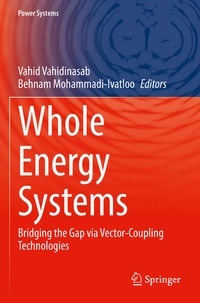
Whole Energy Systems
Bridging the Gap via Vector-Coupling Technologies
1st Edition
Published on 17. February 2023
Book
Paperback/Softback
XIII, 345 pages
978-3-030-87655-5 (ISBN)
Description
This book provides a thorough overview of the concept of whole energy systems and the role of vector-coupling technologies (VCTs) in meeting long-term decarbonization strategies. It is the first comprehensive reference that provides basic definitions and fundamental, applicable approaches to whole energy systems analysis and vector-coupling technologies in a multidisciplinary way. Whole Energy Systems presents practical methods with evidence from applications to real-world and simulated coupled energy systems. Sample analytical examples are provided to aid in the understanding of the presented methods. The book will provide researchers and industry stakeholders focused on whole energy systems, as well researchers and developers from different branches of engineering, energy, economics, and operation research, with state-of-the-art coverage and the latest developments in the field.
More details
Product info
Paperback
Series
Edition
1st ed. 2022
Language
English
Place of publication
Cham
Switzerland
Publishing group
Springer International Publishing
Target group
Professional and scholarly
Illustrations
140
11 s/w Abbildungen, 140 farbige Abbildungen
XIII, 345 p. 151 illus., 140 illus. in color.
Dimensions
Height: 235 mm
Width: 155 mm
Thickness: 20 mm
Weight
546 gr
ISBN-13
978-3-030-87655-5 (9783030876555)
DOI
10.1007/978-3-030-87653-1
Schweitzer Classification
Other editions
Additional editions
Vahid Vahidinasab | Behnam Mohammadi-Ivatloo
Whole Energy Systems
Bridging the Gap via Vector-Coupling Technologies
Book
02/2022
1st Edition
Springer
€149.79
Shipment within 7-9 days
Persons
Vahid Vahidinasab, Ph.D., is a Senior Lecturer at Nottingham Trent University, UK. Before that, he was an Assistant Professor at the Shahid Beheshti University, Iran, and also a Senior Research Associate of power and energy systems at the Newcastle University, UK, and managed the inteGRIDy as an EU Horizon 2020 project. Dr. Vahidinasab also worked with the EPSRC Active Building Centre (ABC) and has had collaborations on joint research works with EPSRC National Centre for Energy Systems Integration and Supergen Energy Networks Hub. His research interests are power and energy systems modeling and analysis, smart grids and microgrids, distributed energy systems integration, as well as and energy markets.
Behnam Mohammadi-Ivatloo, Ph.D., is a member of the Faculty of Engineering with the Department of Electrical and Electronics Engineering at Mugla Sıtkı Koçman University, Turkey. He was previously a Senior Research Fellow at Aalborg University, Denmark. He is also a Professor at the University of Tabriz, from where he is currently on leave. Before joining the University of Tabriz, he was a research associate at the Institute for Sustainable Energy, Environment and Economy at the University of Calgary. He obtained MSc and Ph.D. degrees in electrical engineering from the Sharif University of Technology. His mains research interests are renewable energies, microgrid systems, and smart grids.
Behnam Mohammadi-Ivatloo, Ph.D., is a member of the Faculty of Engineering with the Department of Electrical and Electronics Engineering at Mugla Sıtkı Koçman University, Turkey. He was previously a Senior Research Fellow at Aalborg University, Denmark. He is also a Professor at the University of Tabriz, from where he is currently on leave. Before joining the University of Tabriz, he was a research associate at the Institute for Sustainable Energy, Environment and Economy at the University of Calgary. He obtained MSc and Ph.D. degrees in electrical engineering from the Sharif University of Technology. His mains research interests are renewable energies, microgrid systems, and smart grids.
Content
1) Concept, Definition, and Challenges of Vector Coupling in Whole Energy Systems2) Power-to-X for Renewable Based Hybrid Energy Systems3) Whole Energy Systems Evaluation: A Methodological Framework and Case Study4) Targeting and Design multi-generation system through Total site integration approach5) Investigating the Effective Methods in Improving the Resilience of Electricity and Gas Systems6) Optimal Placement of Combined Heat and Power (CHP) Systems Considering the Cost of Environmental Pollutants7) Optimal Coalition Operation of Interconnected Hybrid Energy Systems Containing Local Energy Conversion Technologies, Renewable Energy Resources, and Energy Storage Systems8) Optimal Co-Generation of Electric and Heatenergy systems considering Heat Energy StorageSystems and CHP units9) Investigating the Role of Flexibility Options in Multi-Vector Energy Systems10) Impact of Demand Response Programs on the Operation of Electricity and Gas Systems11) Two-stage stochastic market-clearing of energy and reserve in the presence of coupled fuel cell-based hydrogen storage system with renewable resources12) Polygeneration Systems in fossil fuel power plants: The role of Power-to-X in CO2 mitigation13) The Role of Distributed Multi-Vector Energy Assets in Economic Decarbonisation: Early Findings of a UK Demonstrator