

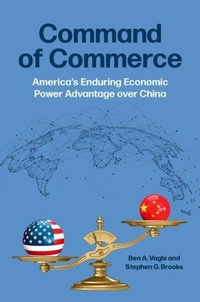
Command of Commerce
America's Enduring Economic Power Advantage over China
Published on 18. April 2025
Book
Hardback
296 pages
978-0-19-780229-8 (ISBN)
Description
The conventional wisdom has held that China's economic power is very close to America's and that Washington cannot undertake a broad economic cutoff of China without hurting itself as much, or more. In Command of Commerce, Ben A. Vagle and Stephen G. Brooks show the conventional wisdom is wrong on both fronts. The authors argue that America's economic power has been underestimated because conventional economic measures have ignored America's unprecedented control over the world's largest multinational corporations. They further argue that China's economic power has been overestimated due to Beijing's manipulation of its economic data and measurement issues presented by China's uniquely structured economy. The authors also show Washington could impose massive, disproportionate harm on Beijing if it imposed a broad economic cutoff on China in cooperation with its allies or via a distant naval blockade. Across six scenarios, China's short-term economic losses from a broad cutoff range from being 5 to 11 times higher than America's. And in the long run, America and almost all its allies would return to previous economic growth levels; in contrast, China's growth would be permanently degraded.
Reviews / Votes
Command of Commerce offers a useful corrective to declinist narratives. It is a sharp, data-rich, and policy-relevant study of how economic power actually works, and why the US is still the commanding force in world politics. * Pal Roren, Journal of Peace Research *More details
Language
English
Place of publication
New York
United States
Product notice
sewn/stitched
Cloth over boards
Illustrations
32 b/w figures; 9 tables
Dimensions
Height: 234 mm
Width: 156 mm
Thickness: 21 mm
Weight
585 gr
ISBN-13
978-0-19-780229-8 (9780197802298)
Copyright in bibliographic data and cover images is held by Nielsen Book Services Limited or by the publishers or by their respective licensors: all rights reserved.
Schweitzer Classification
Other editions
Additional editions
Ben A. Vagle | Stephen G. Brooks
Command of Commerce
America's Enduring Economic Power Advantage over China
Book
04/2025
Oxford University Press Inc
€34.80
Shipment within 15-20 days
Ben A. Vagle | Stephen G. Brooks
Command of Commerce
America's Enduring Economic Power Advantage over China
E-Book
04/2025
OUP eBook
€21.99
Available for download
Ben A. Vagle | Stephen G. Brooks
Command of Commerce
America's Enduring Economic Power Advantage over China
E-Book
04/2025
OUP eBook
€21.99
Available for download
Persons
Ben A. Vagle is a policy analyst at the U.S. Department of the Treasury's Office of Investment Security. Vagle graduated from Dartmouth College, where he was awarded Honors in Economics and Highest Honors in Government. He also received the Rockefeller Prize in International Relations and the Chase Peace Prize for work on his senior thesis, as well as the Economics Department Outstanding Achievement Award. Immediately following his graduation, Vagle worked at Bates White Economic Consulting solving complex data challenges for lawyers and economists.
This book was accepted before Vagles government service, is based entirely on open sources, and does not necessarily reflect the views of the US Government or US Treasury.
Stephen G. Brooks is Professor of Government at Dartmouth and has previously held fellowships at Harvard and Princeton. He is the author of four books: Producing Security: Multinational Corporations, Globalization, and the Changing Calculus of Conflict (2005); World out of Balance: International Relations and the Challenge of American Primacy (with William Wohlforth, 2008); America Abroad: The United States' Global Role in the 21st Century (with William Wohlforth, Oxford, 2016); and Political Economy of Security (forthcoming).
He has published numerous articles in journals such as International Security, International Organization, Foreign Affairs, Journal of Conflict Resolution, Journal of Politics, Perspectives on Politics, and Security Studies. He received his PhD in Political Science with Distinction from Yale University, where his dissertation received the American Political Science Association's Helen Dwight Reid Award for the best doctoral dissertation in international relations, law, and politics.
This book was accepted before Vagles government service, is based entirely on open sources, and does not necessarily reflect the views of the US Government or US Treasury.
Stephen G. Brooks is Professor of Government at Dartmouth and has previously held fellowships at Harvard and Princeton. He is the author of four books: Producing Security: Multinational Corporations, Globalization, and the Changing Calculus of Conflict (2005); World out of Balance: International Relations and the Challenge of American Primacy (with William Wohlforth, 2008); America Abroad: The United States' Global Role in the 21st Century (with William Wohlforth, Oxford, 2016); and Political Economy of Security (forthcoming).
He has published numerous articles in journals such as International Security, International Organization, Foreign Affairs, Journal of Conflict Resolution, Journal of Politics, Perspectives on Politics, and Security Studies. He received his PhD in Political Science with Distinction from Yale University, where his dissertation received the American Political Science Association's Helen Dwight Reid Award for the best doctoral dissertation in international relations, law, and politics.
Content
Chapter 1: Introduction
Chapter 2: Measuring the Distribution of Commercial Capacity
Chapter 3: The Potemkin Superpower
Chapter 4: China's Economic Weapons
Chapter 5: Conceptualizing a Wartime Economic Cutoff of China
Chapter 6: Modeling a Wartime Economic Cutoff of China
Chapter 7: Foreign Policy Implications for America and China
Notes
Appendix
Index
Chapter 2: Measuring the Distribution of Commercial Capacity
Chapter 3: The Potemkin Superpower
Chapter 4: China's Economic Weapons
Chapter 5: Conceptualizing a Wartime Economic Cutoff of China
Chapter 6: Modeling a Wartime Economic Cutoff of China
Chapter 7: Foreign Policy Implications for America and China
Notes
Appendix
Index