

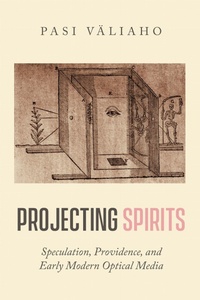
Projecting Spirits
Speculation, Providence, and Early Modern Optical Media
Published on 28. June 2022
Book
Paperback/Softback
272 pages
978-1-5036-3193-9 (ISBN)
Description
The history of projected images at the turn of the seventeenth century reveals a changing perception of chance and order, contingency and form. In Projecting Spirits, Pasi Vaeliaho maps how the leading optical media of the period-the camera obscura and the magic lantern-developed in response to, and framed, the era's key intellectual dilemma of whether the world fell under God's providential care, or was subject to chance and open to speculating.
As Vaeliaho shows, camera obscuras and magic lanterns were variously employed to give the world an intelligible and manageable design. Jesuit scholars embraced devices of projection as part of their pursuit of divine government, whilst the Royal Society fellows enlisted them in their quest for empirical knowledge as well as colonial expansion. Projections of light and shadow grew into critical metaphors in early responses to the turbulences of finance. In such instances, Vaeliaho argues, "projection" became an indispensable cognitive form to both assert providence, and to make sense of an economic reality that was gradually escaping from divine guidance. Drawing on a range of materials-philosophical, scientific and religious literature, visual arts, correspondence, poems, pamphlets, and illustrations-this provocative and inventive work expands our concept of the early media of projection, revealing how they spoke to early modern thinkers, and shaped a new, speculative concept of the world.
As Vaeliaho shows, camera obscuras and magic lanterns were variously employed to give the world an intelligible and manageable design. Jesuit scholars embraced devices of projection as part of their pursuit of divine government, whilst the Royal Society fellows enlisted them in their quest for empirical knowledge as well as colonial expansion. Projections of light and shadow grew into critical metaphors in early responses to the turbulences of finance. In such instances, Vaeliaho argues, "projection" became an indispensable cognitive form to both assert providence, and to make sense of an economic reality that was gradually escaping from divine guidance. Drawing on a range of materials-philosophical, scientific and religious literature, visual arts, correspondence, poems, pamphlets, and illustrations-this provocative and inventive work expands our concept of the early media of projection, revealing how they spoke to early modern thinkers, and shaped a new, speculative concept of the world.
Reviews / Votes
"This commanding, erudite history of the 'magic' that goes with optical technologies makes a major and enduring contribution to visual studies, to the history of science, and to the political economy of images."-Tom Conley, Harvard University "Moving seamlessly from early modern sources to current media studies theories, this book adds subtlety and nuance to our understanding of the ways optical instruments and visual metaphors shaped cultural sensitivities, modes of thought, and economic practices."-Raz Chen-Morris, The Hebrew University of Jerusalem "Pasi Vaeliaho provides a captivating take on projection. Projecting Spirits includes a historically rich and deep understanding of the connection between images and economies of both money and souls. As it maps how the virtual and the imaginary become effective anchors of the real world, this wonderful book amounts to nothing less than a project about time: an invention of such a future that becomes a speculative project."-Jussi Parikka, Aarhus University and FAMU, Prague "Projecting Spirits provides a thought-provoking window into a rarely explored aspect of early modern visual culture."-Paul E. Sampson, H-Sci-Med-Tech "Drawing on a wealth of different sources in multiple languages and from subjects not often brought together in a single argument, Vaeliaho has written an important and compelling book about the early modern cultures of projection."-Paula Findlen, Material ReligionMore details
Edition
New edition
Language
English
Place of publication
Palo Alto
United States
Target group
Professional and scholarly
Edition type
New edition
Product notice
Paperback (trade)
Illustrations
39 halftones
Dimensions
Height: 226 mm
Width: 148 mm
Thickness: 20 mm
Weight
340 gr
ISBN-13
978-1-5036-3193-9 (9781503631939)
Copyright in bibliographic data and cover images is held by Nielsen Book Services Limited or by the publishers or by their respective licensors: all rights reserved.
Schweitzer Classification
Other editions
Additional editions
E-Book
07/2022
Stanford University Press
from
€52.99
Available for download
Book
04/2020
Stanford University Press
€24.00
Shipment within 15-20 days
Person
Pasi Vaeliaho is Professor in History of Art and Visual Studies, University of Oslo. His last book was Biopolitical Screens: Image, Power, and the Neoliberal Brain (2014).
Content
1. The Form of Projection
2. Projection and Providence
3. Government of Souls
4. Projecting Property
5. Shadows of Expectation
Epilogue
2. Projection and Providence
3. Government of Souls
4. Projecting Property
5. Shadows of Expectation
Epilogue