

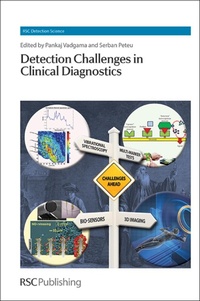
Detection Challenges in Clinical Diagnostics
Will be published approx. on 26. September 2013
Book
Hardback
246 pages
978-1-84973-612-1 (ISBN)
Description
There are many remaining challenges impeding future progress in field of Clinical Diagnostics. This book presents a technical assessment and vision of clinical leaders, scoping the clinical and other diagnostic needs and the bottle-necks in their cognate fields. Issues of real environmental biological measurements from the perspective of the end-user are presented and thus the book serves to inform the direction of the fundamental scientific efforts. Both editors are experienced practitioners within the biosensor technology and are involved first-hand with the healthcare and clinical applications of detection science.
Reviews / Votes
Advances in clinical diagnostic devices are moving exponentially, and it is believed that this sector is only at the beginning of the curve. Star Trek fans will point to the medical 'Tricorder' as the ultimate end result of clinical diagnostic research, but will accept it is probably several centuries away from reality. In contrast, tens of millions of blood samples are routinely drawn daily to be followed by automated and highly efficient analysis to determine the origins, presence or incipient onset of potential illnesses. Most results are guides, rather than specific indicators, that include glucose, electrolytes, blood fats, thyroid function, kidney function, blood cell counts, PSA tests and other ELISA evaluations. Many researchers are currently evaluating the presence of cancer marker proteins with an ever increasing success rate. It is clear once a diagnostic method is clinically approved and automated it becomes a huge resource of relevant and valuable information to the medical profession.Without these data, medical practitioners cannot provide accurate diagnosis and ongoing treatment. Consequently, proven diagnostic devices are needed, in demand and willingly accepted by all parties. There is currently a large gap between technology in use and technology available. Bio-sensors and 'lab-on-a-chip' devices potentially offer rapid label-free measurement, but are sparsely represented in the current universally used routines employed in most hospitals. There is obviously a need to close this gap to the satisfaction of those that pay the health-care bills.
The plethora of recent publications is simply a reflection of the activity in the field and part of the process of reporting another faster, more accurate, hopefully less expensive method to assist diagnosis. This is the second book in the RSC Detection Science Series, and has 28 contributors largely based in the UK but with major contributions from Canada and the USA. The book is divided into nine chapters, with the first two also considering the role that the patient has to play in the overall process. Dry reagent systems for glucose are dealt with in Chapter 3, and Chapter 4 covers electrochemical detection of disease-related diagnostic biomarkers. The advantages/ disadvantages and biocompatibility of in vivo sensors are explained in Chapter 5. Chapter 6 is intriguing. The role of nitrogen oxides in several biological cycles has been well established for many decades, recently evolving into detailed studies of reactive nitrogen and oxygen free radical species. The elusive peroxynitrite radical ONOO- (PON) is highlighted as a potent death cell inducer in several devastating diseases, suggesting early accurate detection would be an important addition to routine analysis. Chapter 7 involves how to classify risk in patients suffering from myelodysplastic syndromes (MDS), and Chapter 8 exemplifies a real-time probe analysis of oesophageal carcinoma.
It is anticipated several more books will evolve in this series, each updating a specific target. For some time to come these can only be little more than a current commentary on the rapidity of change in this essential sector of the medical device industry. -- Ken Jones * Chromatographia (2015) 78:297-298 *
More details
Series
Language
English
Place of publication
Cambridge
United Kingdom
Target group
Professional and scholarly
Product notice
Unsewn / adhesive bound
Dimensions
Height: 238 mm
Width: 163 mm
Thickness: 20 mm
Weight
549 gr
ISBN-13
978-1-84973-612-1 (9781849736121)
Copyright in bibliographic data and cover images is held by Nielsen Book Services Limited or by the publishers or by their respective licensors: all rights reserved.
Schweitzer Classification
Other editions
Additional editions
Pankaj Vadgama | Serban Peteu
Detection Challenges in Clinical Diagnostics
E-Book
09/2013
1st Edition
Royal Society of Chemistry
€192.99
Available for download
Persons
Professor Pankaj Vadgama's particular interest is biosensors, where he has developed permselective, biocompatible, and biomimetic polymeric membranes capable of stable transduction in whole blood and tissue. Both in vivo and in vitro work has been undertaken, including the use of miniaturized devices for glucose and lactate monitoring, immunosensing, and interrogation of tissue-material interactions. Current research work includes interfacial problems relating to sensor/biomaterial contact with the biomatrix, and the generalizable insights that may emerge from this. Projects include: spider silk for tissue engineering, materials for implantable electronic devices, microfluidic based separation, cell-surface interactions, biomaterial degradation dynamics, conducting polymers as biomaterials, tissue bioreactor design, and cochlear implant electrodes. Dr. Serban Peteu's research interest is in biosensors, where he has advanced methods to detect metal ions or monitor nitro-oxidative stress in biological fluids. Both electrochemical and optochemical sensing have been investigated, furthermore the response being enhanced via hybrid organic-inorganic nano-architectures. Present work involves nanowire based bio-catalytic interfaces for electrochemical and field-effect sensors. Projects include: semiconductor based lancet type biosensors, electroactive polymers soft actuators, bioreactors designed and fabricated for vaccine research and for water remediation, other equipment and devices to improve the quality of life.
Content
Introduction;
Sensitive detection as an interface process;
Improved ion-, gas- and bio-sensors;
Long term implantable sensors;
Ultrasensitive Protein microarrays;
Monitoring nitro-oxidative stress;
Nano-bio-interface diagnostics;
Discussion and conclusions
Sensitive detection as an interface process;
Improved ion-, gas- and bio-sensors;
Long term implantable sensors;
Ultrasensitive Protein microarrays;
Monitoring nitro-oxidative stress;
Nano-bio-interface diagnostics;
Discussion and conclusions