

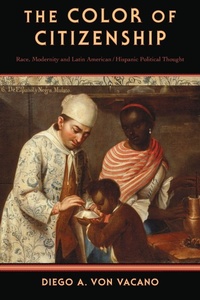
The Color of Citizenship
Race, Modernity and Latin American / Hispanic Political Thought
Published on 13. February 2014
Book
Paperback/Softback
240 pages
978-0-19-936888-4 (ISBN)
Description
The role of race in politics, citizenship, and the state is one of the most perplexing puzzles of modernity. While political thought has been slow to take up this puzzle, Diego von Vacano suggests that the tradition of Latin American and Hispanic political thought, which has long considered the place of mixed-race peoples throughout the Americas, is uniquely well-positioned to provide useful ways of thinking about the connections between race and citizenship. As he argues, debates in the United States about multiracial identity, the possibility of a post-racial world in the aftermath of Barack Obama, and demographic changes owed to the age of mass migration will inevitably have to confront the intellectual tradition related to racial admixture that comes to us from Latin America.
Von Vacano compares the way that race is conceived across the writings of four thinkers, and across four different eras: the Spanish friar Bartolome de Las Casas writing in the context of empire; Simon Bolivar writing during the early republican period; Venezuelan sociologist Laureano Vallenilla Lanz on the role of race in nationalism; and Mexican philosopher Jose Vasconcelos writing on the aesthetic approach to racial identity during the cosmopolitan, post-national period. From this comparative and historical survey, von Vacano develops a concept of race as synthetic, fluid and dynamic -- a concept that will have methodological, historical, and normative value for understanding race in other diverse societies.
Von Vacano compares the way that race is conceived across the writings of four thinkers, and across four different eras: the Spanish friar Bartolome de Las Casas writing in the context of empire; Simon Bolivar writing during the early republican period; Venezuelan sociologist Laureano Vallenilla Lanz on the role of race in nationalism; and Mexican philosopher Jose Vasconcelos writing on the aesthetic approach to racial identity during the cosmopolitan, post-national period. From this comparative and historical survey, von Vacano develops a concept of race as synthetic, fluid and dynamic -- a concept that will have methodological, historical, and normative value for understanding race in other diverse societies.
Reviews / Votes
Diego von Vacano puts Latin American and Hispanic political thought in the forefront as he examines, with originality and precision, the role that race has played and can play in both political thought and theory. As a central factor of the lived experience of individuals in the modern world, race as a synthetic concept illuminates the workings of politics, power, and citizenship and challenges the ways in which race has traditionally been elided in Western political thought. * Henry Louis Gates, Jr., Alphonse Fletcher University Professor, Harvard University * Diego von Vacano's important new book forces us to rethink central assumptions about modernity and race that have long been part of European and North American intellectual traditions. Through the writings of four major Spanish American intellectuals, spanning fully 400 years, 'The Color of Citizenship' explores the evolution of racial ideas based on mixture and fluidity rather than purity and stability. With 'The Color of Citizenship', the important contributions of Latin Americans to thinking about race can no longer be ignored. * Edward Telles, Professor of Sociology, Princeton University * The Color of Citizenship' is an excellent genealogy of racial thinking and post-colonial states in the Americas. Scholars of philosophy, political theory, and race will better understand the complicated and 'synthetic' nature of racial discourse in the Americas from reading this book. * Mark Q. Sawyer, Professor of Political Science & African American Studies, UCLA * By examining what a selected number of Spanish American thinkers had to say about race, regardless of their politics, Diego von Vacano's book is a most valuable contribution on various fronts. It offers a fruitful and exceptional interdisciplinary engagement between political philosophy and the history of ideas, which is also an invitation to take more seriously Latin American political thinkers. More substantially, it traces a 'particular intellectual tradition' towards a 'modern synthetic conceptualization of race,' one that accepts the values of miscegenation against hierarchical and dualistic paradigms of race. By placing a reconceptualised notion of race at the centre of political philosophy, von Vacano identifies the basis of a universally inclusive notion of citizenship. What is discussed here is undoubtedly relevant to key debates in our contemporary societies. * Eduardo Posada-Carbo, Latin American Centre, Oxford University * This stunningly original and thoughtful work demonstrates the tremendous potential of comparative political theory. Highly recommended * CHOICE *More details
Language
English
Place of publication
New York
United States
Target group
College/higher education
Professional and scholarly
Dimensions
Height: 234 mm
Width: 156 mm
Thickness: 14 mm
Weight
415 gr
ISBN-13
978-0-19-936888-4 (9780199368884)
Copyright in bibliographic data and cover images is held by Nielsen Book Services Limited or by the publishers or by their respective licensors: all rights reserved.
Schweitzer Classification
Other editions
Additional editions
Diego von Vacano
The Color of Citizenship
Race, Modernity and Latin American / Hispanic Political Thought
Book
02/2012
Oxford University Press Inc
€170.00
Shipment within 15-20 days
Diego A. von Vacano
The Color of Citizenship
Race, Modernity and Latin American / Hispanic Political Thought
E-Book
01/2012
1st Edition
OUP eBook
€29.49
Available for download
Person
Diego A. von Vacano is Associate Professor of Political Science and Director of the Political Theory Convocation at Texas A&M University. He was previously a Fellow at the Center for Advanced Study in the Behavioral Sciences at Stanford University and at the Institute for Advanced Study in Princeton, and is the author of The Art of Power.
Content
Introduction ; 1. Paradox of Empire: Las Casas and the Birth of Race ; 2. Mixed into Unity: Race and Republic in the Thought of Simon Bolivar ; 3. Race and Nation in the Democratic Caesarism of Vallenilla Lanz ; 4. The Citizenship of Beauty: Jose Vasconcelos's Aesthetic Synthesis of Race ; Conclusion: Making Race Visible to Political Theory