

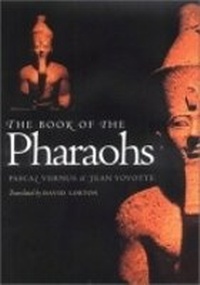
The Book of the Pharaohs
Published on 27. March 2003
Book
Hardback
256 pages
978-0-8014-4050-2 (ISBN)
Description
The names of ancient Egyptian kings such as Cheops, Akhenaten, and Ramesses II have become part of popular culture. Yet, for all the tombs and statuary that have survived over the millennia, surprisingly little remains that speaks to the workings of government, cabals in the palace, political factions, and the private lives of the royal families. In The Book of the Pharaohs, Pascal Vernus and Jean Yoyotte offer an indispensable, basic reference to the full human reality of royal Egypt.
The Book of the Pharaohs is an encyclopedia made up of short essays on the pharaohs themselves, as well as on places, dynasties, personages, subjects, and themes relating to the kings and their rule. Entries range from "Adoratrices" (priestesses of Hathor, the Egyptian Aphrodite, whose role was to arouse the erotic impulse in the creator gods) and "Amarna" (the capital created by the heretic pharaoh Akhenaten) to "Scorpion" (who ruled before the unification of Upper and Lower Egypt) and "Zero Dynasty" (the designation for pre-pharaonic Egypt). In addition, Vernus and Yoyotte include a substantial essay on the sources for Egyptian history, a bibliography of books for general readers, and a chronological table that organizes the major periods of Egyptian history and notes the most illustrious royal names from each.
The Book of the Pharaohs is an encyclopedia made up of short essays on the pharaohs themselves, as well as on places, dynasties, personages, subjects, and themes relating to the kings and their rule. Entries range from "Adoratrices" (priestesses of Hathor, the Egyptian Aphrodite, whose role was to arouse the erotic impulse in the creator gods) and "Amarna" (the capital created by the heretic pharaoh Akhenaten) to "Scorpion" (who ruled before the unification of Upper and Lower Egypt) and "Zero Dynasty" (the designation for pre-pharaonic Egypt). In addition, Vernus and Yoyotte include a substantial essay on the sources for Egyptian history, a bibliography of books for general readers, and a chronological table that organizes the major periods of Egyptian history and notes the most illustrious royal names from each.
Reviews / Votes
"This compact reference work attempts to answer the questions 'What if we tore off King Tut's gold mask? What lies behind the formalism, the hierarchism, and the majesty of the pharaonic monuments?' In response, Vernus, director of studies at the Ecole Pratique des Hautes Etudes, and Yoyotte, chair of Egyptology at the College de France, present brief biographical sketches of each of the pharaohs, with highlights of their lives and reigns, such as military achievements and monuments built. There are also entries for historically relevant peoples and places, such as the Hittites, whose empire competed with that of the pharaohs, and the city of Memphis, strategically located at the juncture of Upper and Lower Egypt. Maps and a chronology of ancient history are useful editions."-Publishers Weekly, June 15, 2003 "Offering easy access to basic information about the pharaohs of ancient Egypt and their world, this work was originally published as Dictionnaire des pharaohs by two French scholars and translated into English by a fellow Egyptologist. . . . One of a number of ancient Near East and ancient Egyptian reference resources that have appeared in recent years, this volume is authoritative and easy to use, priced for interested readers and librarians alike. Summing up: Highly recommended. All collections.-Choice, February 2004More details
Edition
New edition
Language
English
Place of publication
Ithaca
United States
Target group
College/higher education
Professional and scholarly
Edition type
New edition
Dimensions
Height: 235 mm
Width: 156 mm
Weight
567 gr
ISBN-13
978-0-8014-4050-2 (9780801440502)
Copyright in bibliographic data and cover images is held by Nielsen Book Services Limited or by the publishers or by their respective licensors: all rights reserved.
Schweitzer Classification