

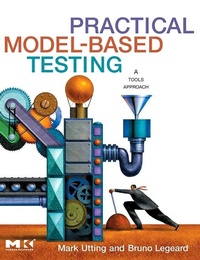
Practical Model-Based Testing
A Tools Approach
Published on 14. March 2007
Book
Hardback
456 pages
978-0-12-372501-1 (ISBN)
Description
Practical Model-Based Testing gives a practical introduction to model-based testing, showing how to write models for testing purposes and how to use model-based testing tools to generate test suites. It is aimed at testers and software developers who wish to use model-based testing, rather than at tool-developers or academics.
The book focuses on the mainstream practice of functional black-box testing and covers different styles of models, especially transition-based models (UML state machines) and pre/post models (UML/OCL specifications and B notation). The steps of applying model-based testing are demonstrated on examples and case studies from a variety of software domains, including embedded software and information systems.
From this book you will learn:
The basic principles and terminology of model-based testing
How model-based testing differs from other testing processes
How model-based testing fits into typical software lifecycles such as agile methods and the Unified Process
The benefits and limitations of model-based testing, its cost effectiveness and how it can reduce time-to-market
A step-by-step process for applying model-based testing
How to write good models for model-based testing
How to use a variety of test selection criteria to control the tests that are generated from your models
How model-based testing can connect to existing automated test execution platforms such as Mercury Test Director, Java JUnit, and proprietary test execution environments
The book focuses on the mainstream practice of functional black-box testing and covers different styles of models, especially transition-based models (UML state machines) and pre/post models (UML/OCL specifications and B notation). The steps of applying model-based testing are demonstrated on examples and case studies from a variety of software domains, including embedded software and information systems.
From this book you will learn:
The basic principles and terminology of model-based testing
How model-based testing differs from other testing processes
How model-based testing fits into typical software lifecycles such as agile methods and the Unified Process
The benefits and limitations of model-based testing, its cost effectiveness and how it can reduce time-to-market
A step-by-step process for applying model-based testing
How to write good models for model-based testing
How to use a variety of test selection criteria to control the tests that are generated from your models
How model-based testing can connect to existing automated test execution platforms such as Mercury Test Director, Java JUnit, and proprietary test execution environments
Reviews / Votes
"This topic is hot...and both authors are well known experts in the community of model-based testing." -Wolfgang Grieskamp, Microsoft ResearchMore details
Language
English
Place of publication
San Francisco
United States
Publishing group
Elsevier Science & Technology
Target group
Professional and scholarly
All those involved in software testing activities, including software test engineers who are in charge of test case design and development, software developers who are looking for better and more automated testing methods, and project managers who lead development teams and who ensure high quality software is produced.
Product notice
sewn/stitched
Paper over boards
Illustrations
Illustrated
Dimensions
Height: 246 mm
Width: 194 mm
Thickness: 32 mm
Weight
1156 gr
ISBN-13
978-0-12-372501-1 (9780123725011)
Copyright in bibliographic data and cover images is held by Nielsen Book Services Limited or by the publishers or by their respective licensors: all rights reserved.
Schweitzer Classification
Other editions
Additional editions
E-Book
07/2010
Morgan Kaufmann
€59.95
Available for download
Book
12/2006
Morgan Kaufmann
€76.50
Shipment within 15-20 days
Persons
Content
1 The Challenge; 2 The Pain and the Gain; 3 A Model of your System; 4 Selecting your Tests; 5 Testing from Finite State Machines; 6 Testing from Pre/Post Models; 7 Testing from UML Models; 8 Making Tests Executable; 9 The GSM 11.11 Case Study; 10 The ATM Case Study; 11 Putting it into Practice; Appendix; Index