

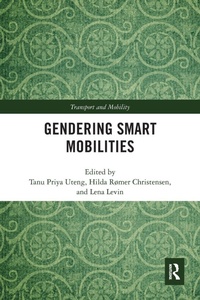
Gendering Smart Mobilities
1st Edition
Published on 13. December 2021
Book
Paperback/Softback
318 pages
978-1-032-24159-3 (ISBN)
Description
This book considers gender perspectives on the 'smart' turn in urban and transport planning to effect-ively provide 'mobility for all' while simultaneously attending to the goal of creating green and inclusive cities. It deals with the conceptualisation, design, planning, and execution of the fast-emerging 'smart' solutions.
The volume questions the efficacy of transformations being brought by smart solutions and highlights the need for a more robust problem formulation to guide the design of smart solutions, and further maps out the need for stronger governance to manage the introduction and proliferation of smart technologies. Authors from a range of disciplinary backgrounds have contributed to this book, designed to converse with mobility studies, transport studies, urban-transport planning, engineering, human geography, sociology, gender studies, and other related fields.
The book fills a substantive gap in the current gender and mobility discourses, and will thus appeal to students and researchers studying mobilities in the social, political, design, technical, and environmental sciences.
The volume questions the efficacy of transformations being brought by smart solutions and highlights the need for a more robust problem formulation to guide the design of smart solutions, and further maps out the need for stronger governance to manage the introduction and proliferation of smart technologies. Authors from a range of disciplinary backgrounds have contributed to this book, designed to converse with mobility studies, transport studies, urban-transport planning, engineering, human geography, sociology, gender studies, and other related fields.
The book fills a substantive gap in the current gender and mobility discourses, and will thus appeal to students and researchers studying mobilities in the social, political, design, technical, and environmental sciences.
More details
Series
Language
English
Place of publication
London
United Kingdom
Publishing group
Taylor & Francis Ltd
Target group
College/higher education
Postgraduate and Undergraduate
Illustrations
37 s/w Abbildungen
37 Illustrations, black and white
Dimensions
Height: 234 mm
Width: 156 mm
Thickness: 17 mm
Weight
488 gr
ISBN-13
978-1-032-24159-3 (9781032241593)
Copyright in bibliographic data and cover images is held by Nielsen Book Services Limited or by the publishers or by their respective licensors: all rights reserved.
Schweitzer Classification
Other editions
Additional editions
Tanu Priya Uteng | Hilda Romer Christensen | Lena Levin
Gendering Smart Mobilities
Book
01/2020
1st Edition
Routledge
€206.90
Shipment within 10-20 days
Tanu Priya Uteng | Hilda Romer Christensen | Lena Levin
Gendering Smart Mobilities
E-Book
12/2019
1st Edition
Routledge
€59.49
Available for download
Tanu Priya Uteng | Hilda Romer Christensen | Lena Levin
Gendering Smart Mobilities
E-Book
12/2019
1st Edition
Routledge
€59.49
Available for download
Persons
Tanu Priya Uteng (PhD) is Senior Researcher at the Institute of Transport Economics in Oslo, Norway. She has worked and published across a host of cross-cutting issues in the field of urban and transport planning over the past 16 years. Her works builds on cross-fertilising urban mobilities, transport-related social exclusion, gendered mobilities, travel behaviour studies, transport modelling, and inclusive planning. She is currently leading long-term strategic EU and Research Council pro-jects on designing inclusive urban spaces, first-last mile connectivity, climate change and transport planning, green-shift, and shared mobilities. Her previous edited works include Gendered Mobilities and Urban Mobilities in the Global South.
Hilda Romer Christensen (PhD) is Associate Professor and Head of Coordination for Gender Studies, University of Copenhagen. She also heads Gender Certificate, an interdisciplinary educa-tional initiative on Gender and Body Dynamics. She has written extensively on gender, culture, and more lately on gender in transport in comparative perspectives. She is currently leading a research project focused on World Dynamics in Micro Perspectives: (Re)making Middle Class Families, China and Denmark, including housing, mobility and transport, and is a scientific coordinator for the Horizon 2020 project TINNGO, focusing on gender, transport, and smart mobilities (2019-2021).
Lena Levin (PhD) is Senior Researcher at the unit Mobility, Actors and Planning Processes (MAP) within the Swedish National Road and Transport Research Institute (VTI). She is also a participant at K2, The Swedish Knowledge Centre for Public Transport. Her research centres on how the trans-port system is shaped, developed, and utilised by actors with various interests, perspectives, and ascendancy (e.g. how policy is construed and implemented in planning processes; interaction between experts and citizens; and how participants interact in mobile settings). She is a partner of the EU project Transport Innovation Gender Observatory (TInnGO) (2019-2021).
Hilda Romer Christensen (PhD) is Associate Professor and Head of Coordination for Gender Studies, University of Copenhagen. She also heads Gender Certificate, an interdisciplinary educa-tional initiative on Gender and Body Dynamics. She has written extensively on gender, culture, and more lately on gender in transport in comparative perspectives. She is currently leading a research project focused on World Dynamics in Micro Perspectives: (Re)making Middle Class Families, China and Denmark, including housing, mobility and transport, and is a scientific coordinator for the Horizon 2020 project TINNGO, focusing on gender, transport, and smart mobilities (2019-2021).
Lena Levin (PhD) is Senior Researcher at the unit Mobility, Actors and Planning Processes (MAP) within the Swedish National Road and Transport Research Institute (VTI). She is also a participant at K2, The Swedish Knowledge Centre for Public Transport. Her research centres on how the trans-port system is shaped, developed, and utilised by actors with various interests, perspectives, and ascendancy (e.g. how policy is construed and implemented in planning processes; interaction between experts and citizens; and how participants interact in mobile settings). She is a partner of the EU project Transport Innovation Gender Observatory (TInnGO) (2019-2021).
Content
Prologue PART I Setting the stage 1 Gendering smart mobilities: an introduction 2 Smart mobility - for all? Gender issues in the context of new mobility concepts 3 Couples, the car, and the gendering of the life course: what ordinary trip diary data from the past may tell us about smart mobilities in the future 4 Towards an anthropology of transport affect: the place of emotions, gender, and power in smart mobilities PART II Smart mobilities and overlaps 5 Gender-sensitive mobility socialisation: understanding mode choice of children and adolescents from a gender perspective 6 Smart cities, smart mobilities, and children 7 Cycling London: an intersectional feminist perspective 8 Smart gendered mobilities and lessons for gendered smart mobilities: economic migrants in Bristol, UK PART III Case studies 9 Gender equality and 'smart' mobility: a need for planning to address the real needs of all citizens 10 The gendered dimension of multimodality: exploring the bike-sharing scheme of Oslo 11 User experiences and perceptions of women-only transport services in Mexico 12 Smart biking as gendered innovations and smart city experiment? The case of Mobike in China 13 Gendering smart mobilities in Latin America: are 'smart cities' smart enough to improve social justice? 14 Smart as agency and human interaction: exploring the work of women bus conductors in Bengaluru, India 15 Some gender equality and equity planning cases in urban planning in Malmoe, or how I became a transport feminist Summing up Epilogue: towards an intersectional understanding of transport transitions Index