

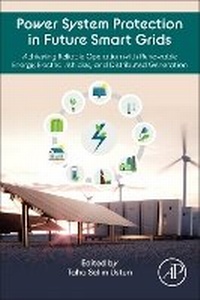
Power System Protection in Future Smart Grids
Achieving Reliable Operation with Renewable Energy, Electric Vehicles, and Distributed Generation
Published on 23. August 2023
Book
Paperback/Softback
242 pages
978-0-323-91780-3 (ISBN)
Description
Power System Protection in Future Smart Grids: Achieving Reliable Operation with Renewable Energy, Electric Vehicles and Distributed Generation demonstrates how to protect smart, highly renewable, and highly distributed power systems with state-of-the-art methods rooted in adaptive protection and dynamic response, and based on continuous communication. Focusing on the implementation of novel protection schemes, each chapter presents solutions accompanied by figurative elements and demonstrator codes in MATLAB, C, Python and Java. Chapters address active distribution networks, hybrid microgrids, EVs and inverters on fault levels, adaptive protection systems, dynamic protection strategies, and Hardware in the Loop (HiL) approaches.
More details
Language
English
Place of publication
Oxford
United Kingdom
Publishing group
Elsevier Science & Technology
Target group
Professional and scholarly
Early career researchers with interests in the impacts of renewable energy on power system operation or power system protection issues in future smart grids. Graduate students.
Power System Engineers.Dimensions
Height: 229 mm
Width: 152 mm
Weight
390 gr
ISBN-13
978-0-323-91780-3 (9780323917803)
Copyright in bibliographic data and cover images is held by Nielsen Book Services Limited or by the publishers or by their respective licensors: all rights reserved.
Schweitzer Classification
Other editions
Additional editions
Taha Selim Ustun
Power System Protection in Future Smart Grids
Achieving Reliable Operation with Renewable Energy, Electric Vehicles, and Distributed Generation
E-Book
08/2023
Academic Press
€144.00
Available for download
Person
Taha Selim Ustun received his Ph.D. degree in electrical engineering from Victoria University, Melbourne, VIC, Australia. Currently, he is a researcher at Fukushima Renewable Energy Institute, AIST (FREA) and leads the Smart Grid Cybersecurity Lab. Prior to that he was an Assistant Professor of Electrical Engineering with the School of Electrical and Computer Engineering, Carnegie Mellon University, Pittsburgh, PA, USA. His research focuses on novel protection challenges that are encountered in new generation power systems, particularly in the development of new protection coordination techniques, communication approaches and testing procedures. With the aim of achieving duplicable and scalable solutions, his research also focuses on standards such as IEC 61850. Recently, his research has concentrated on achieving safe and reliable operation under cyberattacks given the unprecedented cybersecurity vulnerabilities inherent in highly connected smart grids.
Content
1. Introduction - Changing Paradigms in Power Networks
2. Protection of Active Distribution Networks
3. Protection of Hybrid Microgrids with High Renewable Share
4. Fault Current Contributions of EVs and Inverters on fault levels
5. Adaptive Protection Scheme Approaches
6. Role of communication in Dynamic Protection Strategies
7. IEc 61850 modeling of an adaptive protection system for microgrids with high renewables
8. Hardware in the loop testing approaches for fault current studies
9. Protection of DC Microgrids
10. Conclusions and Future work
2. Protection of Active Distribution Networks
3. Protection of Hybrid Microgrids with High Renewable Share
4. Fault Current Contributions of EVs and Inverters on fault levels
5. Adaptive Protection Scheme Approaches
6. Role of communication in Dynamic Protection Strategies
7. IEc 61850 modeling of an adaptive protection system for microgrids with high renewables
8. Hardware in the loop testing approaches for fault current studies
9. Protection of DC Microgrids
10. Conclusions and Future work