

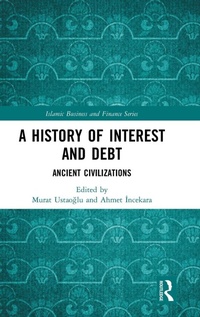
A History of Interest and Debt
Ancient Civilizations
1st Edition
Published on 10. July 2020
Book
Hardback
134 pages
978-0-367-48488-0 (ISBN)
Description
With the spread of interest-based transactions, major problems such as inequality, poverty and debt-based slavery have emerged. Those who practiced professions such as usury have, despite the negative connotations attributed to them, contributed extensively to the construction of the conventional financial system in the global economy, suggesting that the core concepts in this practice need to be analyzed in greater depth and from a historical perspective.
This book analyzes the evolution of interest-bearing debt transactions from ancient times to the era of Abrahamic religions. In modern times, interest is strictly prohibited by Islam, but this book demonstrates that it is a practice that has been condemned and legally and morally prohibited in other civilizations, long before Islam outlawed it. Exploring the roots of this prohibition and how interest has been justified as a viable practice in economic and financial transactions, the book offers deep insight into the current nature of finance and economics, and the distinctive features of Islamic finance in particular and enables researchers to further delve into a review of interest-free financing models. Islamic finance, or alternative financial methods, have become extremely popular particularly in the aftermath of global financial crises, suggesting that they will attract further interest in the future as well.
The book is primarily aimed at undergraduate and graduate students but, as it avoids the use of technical jargon, it also speaks to a general readership. It will appeal to those who have an interest in financial history, particularly the history of debt as well.
This book analyzes the evolution of interest-bearing debt transactions from ancient times to the era of Abrahamic religions. In modern times, interest is strictly prohibited by Islam, but this book demonstrates that it is a practice that has been condemned and legally and morally prohibited in other civilizations, long before Islam outlawed it. Exploring the roots of this prohibition and how interest has been justified as a viable practice in economic and financial transactions, the book offers deep insight into the current nature of finance and economics, and the distinctive features of Islamic finance in particular and enables researchers to further delve into a review of interest-free financing models. Islamic finance, or alternative financial methods, have become extremely popular particularly in the aftermath of global financial crises, suggesting that they will attract further interest in the future as well.
The book is primarily aimed at undergraduate and graduate students but, as it avoids the use of technical jargon, it also speaks to a general readership. It will appeal to those who have an interest in financial history, particularly the history of debt as well.
More details
Series
Language
English
Place of publication
London
United Kingdom
Publishing group
Taylor & Francis Ltd
Target group
College/higher education
Illustrations
1 s/w Tabelle
1 Tables, black and white
Dimensions
Height: 240 mm
Width: 161 mm
Thickness: 13 mm
Weight
402 gr
ISBN-13
978-0-367-48488-0 (9780367484880)
Copyright in bibliographic data and cover images is held by Nielsen Book Services Limited or by the publishers or by their respective licensors: all rights reserved.
Schweitzer Classification
Other editions
Additional editions
Book
04/2022
1st Edition
Routledge
€64.40
Shipment within 15-20 days
E-Book
05/2020
1st Edition
Routledge
€59.49
Available for download
E-Book
05/2020
1st Edition
Routledge
€59.49
Available for download
Persons
Murat Ustaoglu is an associate professor of economics at Istanbul University, Istanbul, Turkey, and currently a visiting scholar at the City University of New York, USA.
Ahmet Incekara is a professor of economics at Istanbul University, Istanbul, Turkey.
Ahmet Incekara is a professor of economics at Istanbul University, Istanbul, Turkey.
Content
1. An introduction to interest and debt 2. Dynamics of Social Life in Ancient Mesopotamian Civilizations as Historical Precursors of Interest/riba within the Context of Religion, Politics and Economics 3. Institutional Interest-bearing Debt in Ancient Civilizations: Sumerian Era 4. TheMerchant Societies and Usury: Assyrians and Babylonians 5. Social Costs of Interest-bearing Debt in Ancient Greece 6. Debt and Politics in Ancient Roman 7. Interest-bearing Debt in Ancient Egypt 8. Interest and Debt in Ancient China 9. Dynamics of Interest-bearing Debt in Hinduism 10. Interest and Debt in the Buddhist Economic Doctrine 11. Interest and Debt in Ancient Era