

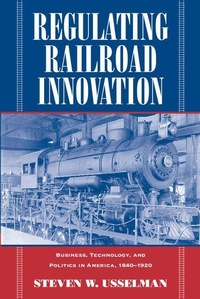
Regulating Railroad Innovation
Business, Technology, and Politics in America, 1840-1920
Published on 11. March 2002
Book
Paperback/Softback
416 pages
978-0-521-00106-9 (ISBN)
Description
Efforts to create and mould new technologies have been a central, recurrent feature of the American experience since at least the time of the Revolution. In Regulating Railroad Innovation, historian Steven Usselman brings this neglected aspect of American history to light. For nearly a century, railroad technology persistently posed novel challenges for Americans, prompting them to re-examine their most cherished institutions and beliefs. Business managers, inventors, consumers, and politicians all strained to contain the forces of innovation and to channel technical change toward the ends they desired. Moving through time from the first experimental lines through the polished but troubled railroad machines of the early twentieth century, Usselman examines diverse forums ranging from legislatures, and evolving corporate bureaucracies to laboratories, engineering societies, and world's fairs. In the process, his book situates technology within the dynamic history of an emergent industrial nation and elucidates its enduring place in American society.
Reviews / Votes
'The authors's interdisciplinary stance has enabled him to demonstrate the nature of the interelations and interactions which have taken place between the various elements of the railroad system and to present us with an holist view of the railroad industry. Such an exceptionally detailed and well researched study is uncommon. Its high order of scholarship, and combination of breadth and assiduity, enables the author to make an original, stimulating and valuable contribution to the field of contemporary business history.' Economic History Review 'Regulating Railroad Innovation is an awesome volume. Steven Usselman displays the skills of a craftsman in weaving together an interdisciplinary story that shows how technology is central to understanding the development of the world's leading industrializing economy.' American Nineteenth Century History 'Such an exceptionally detailed and well-researched study is uncommon. Its high order of scholarship, and its combination of breadth and assiduity, enable [Usselman] to make an original, stimulating, and valuable contribution to the field of contemporary business history.' The Economic History Review 'For those interested in the questions of innovation and technological adaptation and adoption in late nineteenth-century railroads, they will find much to consider.' Business History 'This superb book should be required reading for anyone with the slightest interest in understanding the transformation of the United States from its predominantly rural condition in the mid-nineteenth century to the urbanized and industrial society found in the immediate aftermath of the First World War ... Usselman's magisterial command of the sweep of American political debate on technology over the best part of a century brilliantly contextualizes his myriad detailed insights into the evolution of the railroad machine. This book deserves to become a classic text on American history in the modern period.' Journal of Urban HistoryMore details
Language
English
Place of publication
Cambridge
United Kingdom
Target group
College/higher education
Professional and scholarly
Product notice
Paperback (trade)
Illustrations
28 Halftones, unspecified
Dimensions
Height: 229 mm
Width: 152 mm
Thickness: 24 mm
Weight
672 gr
ISBN-13
978-0-521-00106-9 (9780521001069)
Copyright in bibliographic data and cover images is held by Nielsen Book Services Limited or by the publishers or by their respective licensors: all rights reserved.
Schweitzer Classification
Other editions
Additional editions
Steven W. Usselman
Regulating Railroad Innovation
Business, Technology, and Politics in America, 1840-1920
E-Book
01/2005
1st Edition
Cambridge University Press
€36.99
Available for download
Person
Content
Part I. Assembling the Machine, 1840-76: 1. Engines of expansion and extraction: the politics of development; 2. Acquiring technology: insider innovation; 3. Patent problems: inventors and the market for technology; Part II. Running the Machine, 1876-1904: 4. Patent remedies: politics, jurisprudence, and procedure; 5. Mastering technology, channeling change; 6. Standardizing steel rails: engineered innovation; 7. Engineering enshrined; Part III. Friction in the Machine, 1904-20: 8. Reluctant innovators: the annoying allure of automatic train control; 9. The limits of engineering: rate regulation and the course of innovation; Epilogue: the enduring challenge of innovation.