

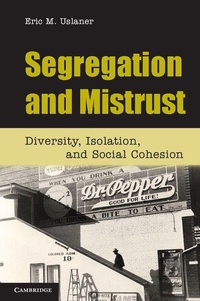
Segregation and Mistrust
Diversity, Isolation, and Social Cohesion
Published on 17. September 2012
Book
Paperback/Softback
284 pages
978-0-521-15163-4 (ISBN)
Description
Generalized trust - faith in people you do not know who are likely to be different from you - is a value that leads to many positive outcomes for a society. Yet some scholars now argue that trust is lower when we are surrounded by people who are different from us. Eric M. Uslaner challenges this view and argues that residential segregation, rather than diversity, leads to lower levels of trust. Integrated and diverse neighborhoods will lead to higher levels of trust, but only if people also have diverse social networks. Professor Uslaner examines the theoretical and measurement differences between segregation and diversity and summarizes results on how integrated neighborhoods with diverse social networks increase trust in the United States, Canada, the United Kingdom, Sweden and Australia. He also shows how different immigration and integration policies toward minorities shape both social ties and trust.
Reviews / Votes
'In an area that has generated more heat than light, Uslaner provides piercing insights and a masterly overview of a complex and sprawling literature.' Miles Hewstone, University of Oxford 'How can we build trust in societies that are inexorably becoming more diverse? Crunching data from five nations - Australia, Canada, Sweden, the UK, and the US - Eric Uslaner argues that governments that want to boost trust must reduce segregation. Thoroughly researched and provocatively written, this book makes a major contribution to our understanding of one of the biggest issues of our age. Its breadth of empirical analysis and depth of scholarship make it vital reading for policy makers and scholars everywhere.' Dr Andrew Leigh MP, Parliament of Australia 'Segregation and Mistrust is an unusually important book for both social science and social policy. Uslaner emphasizes the critical role of group segregation. And he emphatically answers the widely publicized claim that diversity inevitably leads to mistrust and prejudice. With data from five nations, Uslaner emphasizes the critical role of segregation.' Thomas Pettigrew, University of California, Santa CruzMore details
Language
English
Place of publication
Cambridge
United Kingdom
Target group
Professional and scholarly
Product notice
Paperback (trade)
Illustrations
9 Tables, unspecified; 3 Halftones, unspecified; 41 Line drawings, unspecified
Dimensions
Height: 229 mm
Width: 152 mm
Thickness: 16 mm
Weight
421 gr
ISBN-13
978-0-521-15163-4 (9780521151634)
Copyright in bibliographic data and cover images is held by Nielsen Book Services Limited or by the publishers or by their respective licensors: all rights reserved.
Schweitzer Classification
Other editions
Additional editions
E-Book
10/2012
1st Edition
Cambridge University Press
€26.49
Available for download
Book
09/2012
Cambridge University Press
€108.50
Shipment within 15-20 days
Person
Eric M. Uslaner is Professor of Government and Politics at the University of Maryland, College Park. He is also Senior Research Fellow at the Center for American Law and Political Science, Southwest University of Political Science and Law, Chongqing, China and Honorary Professor of Political Science at Aarhus University, Denmark. He is the founding editor of the Sage University Papers on Quantitative Applications in the Social Sciences and has served on the editorial boards of the Journal of Politics, American Politics Quarterly, Social Science Quarterly, Political Research Quarterly and the Journal of Trust Research. Professor Uslaner is author or editor of twelve books, including Corruption, Inequality, and the Rule of Law (Cambridge University Press, 2008) and The Moral Foundations of Trust (Cambridge University Press, 2002). He received his PhD from Indiana University.
Content
Preface; 1. Trust, diversity, and segregation; 2. Contact, diversity, and segregation; 3. Building trust in a segregated society: the United States; 4. Canada: trust, integration, and the search for identity; 5. The United Kingdom: sleepwalking or wide awake?; 6. Sweden and Australia: newer immigrants, trust, and multiculturalism; 7. Altruism and segregation; 8. Where you sit depends on where you stand; 9. The farmer's daughter and intergroup contact.