

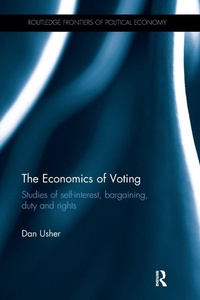
The Economics of Voting
Studies of self-interest, bargaining, duty and rights
1st Edition
Published on 24. January 2018
Book
Paperback/Softback
334 pages
978-1-138-49543-2 (ISBN)
Description
The economics of voting is about whether and to what extent self-interest may be relied upon in voting. The central proposition in economics is that the world's work gets done satisfactorily when each person does what they think is best for themselves. The commonsense view of the matter is that this outcome alone would be chaos.
This book examines voting in four key terms: self-interest, bargaining, duty and rights. Self-interest creates a voting equilibrium on various issues, notably the redistribution of income. Bargaining has a larger role to play in voting than in commerce, as it becomes essential in the formation of platforms of political parties and for the passage of laws. A duty to vote arises from the fact that a person's vote has only an infinitesimal chance of influencing the outcome of an election. Rights are a democracy's first line of defense against exploitation that, unless constrained, the majority rule voting enables voters to expropriate the corresponding minority, undermining democracy completely.
Four key questions are asked in this book. When is there self-interest in majority rule voting comparable to the general interest in markets? To what extent does 'government by majority rule voting' depend upon bargaining as well as voting? Can willingness to vote be attributed to self-interest or is a sense of duty required? Does democracy require property rights? Through an examination of these terms, this book argues that they are indispensable requirements for the maintenance of government by majority rule voting. This book is essential for those who study political economy, economic theory and philosophy as well as political theory.
This book examines voting in four key terms: self-interest, bargaining, duty and rights. Self-interest creates a voting equilibrium on various issues, notably the redistribution of income. Bargaining has a larger role to play in voting than in commerce, as it becomes essential in the formation of platforms of political parties and for the passage of laws. A duty to vote arises from the fact that a person's vote has only an infinitesimal chance of influencing the outcome of an election. Rights are a democracy's first line of defense against exploitation that, unless constrained, the majority rule voting enables voters to expropriate the corresponding minority, undermining democracy completely.
Four key questions are asked in this book. When is there self-interest in majority rule voting comparable to the general interest in markets? To what extent does 'government by majority rule voting' depend upon bargaining as well as voting? Can willingness to vote be attributed to self-interest or is a sense of duty required? Does democracy require property rights? Through an examination of these terms, this book argues that they are indispensable requirements for the maintenance of government by majority rule voting. This book is essential for those who study political economy, economic theory and philosophy as well as political theory.
More details
Series
Language
English
Place of publication
London
United Kingdom
Publishing group
Taylor & Francis Ltd
Target group
College/higher education
Illustrations
51 s/w Abbildungen, 51 s/w Zeichnungen, 21 s/w Tabellen
21 Tables, black and white; 51 Line drawings, black and white; 51 Illustrations, black and white
Dimensions
Height: 234 mm
Width: 156 mm
Thickness: 19 mm
Weight
532 gr
ISBN-13
978-1-138-49543-2 (9781138495432)
Copyright in bibliographic data and cover images is held by Nielsen Book Services Limited or by the publishers or by their respective licensors: all rights reserved.
Schweitzer Classification
Other editions
Additional editions
E-Book
12/2015
Routledge
€67.49
Available for download
E-Book
12/2015
Routledge
€67.49
Available for download
Book
12/2015
1st Edition
Routledge
€242.60
Shipment within 10-20 days
Person
Dan Usher is Professor Emeritus at Queen's University, Kingston, Ontario, Canada.
Content
I. Introduction II. Voting Patterns III. Voting about the Redistribution of Income IV. How High Might the Revenue-maximizing Tax Rate Be? V. Bargaining and Voting VI. Bargaining Unexplained VII. What Exactly is a Duty to Vote? VIII. An Alternative Explanation of the Chance of Casting a Pivotal Vote IX. The Problem of Equity X. Voting Rights, Property Rights and Civil Rights XI. Assessing the Citizen-candidate Model XII. The Significance of the Probabilistic Voting Theorem