

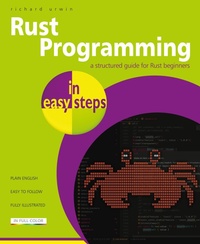
Rust Programming in easy steps
Published on 27. February 2026
Book
Paperback/Softback
192 pages
978-1-78791-034-8 (ISBN)
Description
Rust Programming in easy steps is a practical, no-nonsense guide to Rust for developers who want to write fast, modern systems code. Start by installing and configuring Rust and VSCode, then work through the working examples. Use free, downloadable code to get started now. Covers:
Rust's fundamental principles.
Structuring data effectively and controlling program flow.
Collections and modules.
The file structure of a project.
Implementing behaviors using traits.
Closures and iterators, and real-world programs.
Applying smart pointers and harnessing concurrency.
Focuses on clarity and correctness, making it ideal for practicing programmers who want to adopt Rust with confidence. Your first step to becoming a Rust guru!
Covers Rust 2024, which was released in February 2025.
Rust's fundamental principles.
Structuring data effectively and controlling program flow.
Collections and modules.
The file structure of a project.
Implementing behaviors using traits.
Closures and iterators, and real-world programs.
Applying smart pointers and harnessing concurrency.
Focuses on clarity and correctness, making it ideal for practicing programmers who want to adopt Rust with confidence. Your first step to becoming a Rust guru!
Covers Rust 2024, which was released in February 2025.
More details
Series
Language
English
Place of publication
Southam
United Kingdom
Target group
Professional and scholarly
Product notice
Paperback (UK-trade)
Illustrations
Full colour screenshots, photographs, and diagrams; Illustrations
Dimensions
Height: 184 mm
Width: 225 mm
Thickness: 12 mm
Weight
392 gr
ISBN-13
978-1-78791-034-8 (9781787910348)
Copyright in bibliographic data and cover images is held by Nielsen Book Services Limited or by the publishers or by their respective licensors: all rights reserved.
Schweitzer Classification
Person
Richard Urwin has been a software engineer all his working life, specialising in embedded control systems. He enjoys roleplaying games, science-fiction and hill-walking, although these days he wishes the hills were flatter. He wrote his first Artificial Intelligence program in 1975 and has retained an interest in the field ever since.
Content
Introduction
Fundamental principles
Saying hello
Structuring data
Control flow
Collections & modules
File structure of a project
Implementations
Closures and iterators
Real-world programs
Smart pointers and concurrency
Advanced topics
Fundamental principles
Saying hello
Structuring data
Control flow
Collections & modules
File structure of a project
Implementations
Closures and iterators
Real-world programs
Smart pointers and concurrency
Advanced topics