

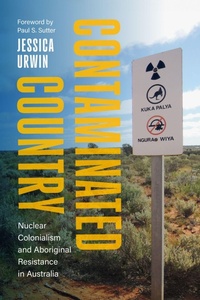
Contaminated Country
Nuclear Colonialism and Aboriginal Resistance in Australia
Published on 9. September 2025
Book
Paperback/Softback
326 pages
978-0-295-75379-9 (ISBN)
Description
The destruction and defiance that swirled around Australia's embrace of the world's nuclear order
Though a nonnuclear state, Australia was embroiled in the military and civilian nuclear energy programs of numerous global powers across the twentieth century. From uranium extraction to nuclear testing, Australia's lands became sites of imperial exploitation under the guise of national development. The continent was subject to rampant nuclear colonialism. However, this history is not just one of imposition. Aboriginal communities, bearing the brunt of these processes, have persistently resisted, reclaiming their rights to Country and demanding reparations.
As Jessica Urwin shows, extraction, weapons testing, and nuclear waste disposal have caused incalculable physical, spiritual, and cultural harm to Aboriginal communities and lands. Yet Indigenous peoples all over the world have not only survived nuclear colonialism but challenged it time and time again. Tracking the colonial mechanisms Australia used to pursue a nuclear industry, Urwin simultaneously highlights how Aboriginal peoples refused and reshaped those same mechanisms over time. A groundbreaking book, Contaminated Country reveals how Australia's deep nuclear past has been entangled with colonialism locally, nationally, and internationally.
Though a nonnuclear state, Australia was embroiled in the military and civilian nuclear energy programs of numerous global powers across the twentieth century. From uranium extraction to nuclear testing, Australia's lands became sites of imperial exploitation under the guise of national development. The continent was subject to rampant nuclear colonialism. However, this history is not just one of imposition. Aboriginal communities, bearing the brunt of these processes, have persistently resisted, reclaiming their rights to Country and demanding reparations.
As Jessica Urwin shows, extraction, weapons testing, and nuclear waste disposal have caused incalculable physical, spiritual, and cultural harm to Aboriginal communities and lands. Yet Indigenous peoples all over the world have not only survived nuclear colonialism but challenged it time and time again. Tracking the colonial mechanisms Australia used to pursue a nuclear industry, Urwin simultaneously highlights how Aboriginal peoples refused and reshaped those same mechanisms over time. A groundbreaking book, Contaminated Country reveals how Australia's deep nuclear past has been entangled with colonialism locally, nationally, and internationally.
Reviews / Votes
"Urwin sensitively traces the history of nuclear colonialism and its impacts in Australia . . . . Contaminated Country will be of interest to environmental historians and historians of Australia, as well as scholars from science and technology studies (STS) and the environmental social sciences. The book, too, should be of interest to a more general Australian public, as Australians continue to grapple with the nation's settlercolonial past and ongoing present." * H-Net Reviews * "[A] thorough, insightful, and first-of-its-kind history of nuclear colonialism in Australia." * American Historical Review * "Contaminated Country is a worthy addition to scholarship on the complex consequences for Aboriginal Australians of nuclear-associated industries and activities in Australia. The book concisely draws together numerous strands, showing convincingly that nuclear-related harms are inextricably entangled with colonial structures, and that these have been enforced by successive Australian governments, not imposed from outside." * Australian Historical Studies * "Urwin's book puts Aboriginal viewpoints front and center, signaling a shift within environmental history scholarship to foreground Indigenous ways of knowing. . . . Going further than correcting the record, Contaminated Country rejects the exceptionalism of the nuclear age and resituates Australian nuclear colonialism in a much longer (and ongoing) history of minerals-obsessed colonizing and staunch Aboriginal-led resistance." * Technology and Culture * "In bridging the gap between nuclear and colonial history in Australia, Contaminated Country has prized open new vistas of research, giving much-needed conceptual and empirical heft to nuclear colonialism as a research field." * Journal of Imperial and Commonwealth History *More details
Series
Language
English
Place of publication
Seattle
United States
Target group
Professional and scholarly
US School Grade: College Graduate Student
Product notice
Paperback (trade)
Illustrations
4 Maps; 4 Maps; 4 Maps; 4 Maps; 4 Maps; 4 Maps; 4 Maps; 4 Maps; 4 Maps; 4 Maps; 4 Maps; 4 Maps; 4 Maps; 4 Maps; 4 Maps; 4 Maps; 4 Maps; 4 Maps; 4 Maps; 11 Illustrations, black and white; 11 Illustrations, black and white; 11 Illustrations, black and white; 11 Illustrations, black and white; 11 Illustrations, black and white; 11 Illustrations, black and white; 11 Illustrations, black and white; 11 Illustrations, black and white; 11 Illustrations, black and white; 11 Illustrations, black and white; 11 Illustrations, black and white; 11 Illustrations, black and white; 11 Illustrations, black and white; 11 Illustrations, black and white; 11 Illustrations, black and white; 11 Illustrations, black and white; 11 Illustrations, black and white; 11 Illustrations, black and white; 11 Illustrations, black and white
Dimensions
Height: 150 mm
Width: 229 mm
Thickness: 23 mm
Weight
488 gr
ISBN-13
978-0-295-75379-9 (9780295753799)
Copyright in bibliographic data and cover images is held by Nielsen Book Services Limited or by the publishers or by their respective licensors: all rights reserved.
Schweitzer Classification