

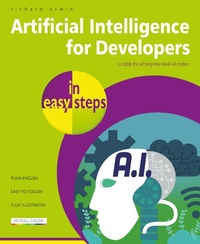
Artificial Intelligence for Developers in easy steps
Published on 9. August 2024
Book
Paperback/Softback
192 pages
978-1-78791-011-9 (ISBN)
Description
Artificial Intelligence for Developers in easy steps is for coders who want to enhance their skillset quickly and easily. Artificial Intelligence (AI) is here to stay, and this guide reveals how AI works and illustrates how to build AI applications. It even covers no-code AI tools. This primer comes with free downloadable source code to get you started straightaway. Topics covered include:
Creating a chatbot.
Building an expert system.
Understanding the flatworld, fuzzy logic, and subsumption architecture.
Genetic algorithms, neural networks, generative AI, and low code.
Aimed at aspiring developers and students who are familiar with Python and now want to master AI concepts and build intelligent AI solutions.
AI programming is mainstream now. Update your coding skills and stay on top!
Creating a chatbot.
Building an expert system.
Understanding the flatworld, fuzzy logic, and subsumption architecture.
Genetic algorithms, neural networks, generative AI, and low code.
Aimed at aspiring developers and students who are familiar with Python and now want to master AI concepts and build intelligent AI solutions.
AI programming is mainstream now. Update your coding skills and stay on top!
More details
Series
Language
English
Place of publication
Southam
United Kingdom
Target group
Professional and scholarly
Illustrations
Full colour screenshots, photographs, and diagrams
Dimensions
Height: 226 mm
Width: 186 mm
Thickness: 11 mm
Weight
390 gr
ISBN-13
978-1-78791-011-9 (9781787910119)
Copyright in bibliographic data and cover images is held by Nielsen Book Services Limited or by the publishers or by their respective licensors: all rights reserved.
Schweitzer Classification
Person
Richard Urwin has been a software engineer all his working life, specialising in embedded control systems. He enjoys roleplaying games, science-fiction and hill-walking, although these days he wishes the hills were flatter. He wrote his first Artificial Intelligence program in 1975 and has retained an interest in the field ever since.
Content
Introducing artificial intelligence
Creating a chatbot
Expert systems
The flatworld
Fuzzy logic
Subsumption architecture
Genetic algorithms
Neural networks
Pretrained neural networks
Generative artificial intelligence
Low code
Creating a chatbot
Expert systems
The flatworld
Fuzzy logic
Subsumption architecture
Genetic algorithms
Neural networks
Pretrained neural networks
Generative artificial intelligence
Low code