

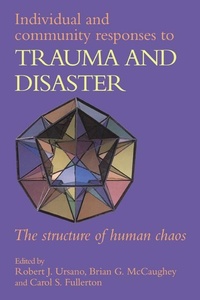
Individual and Community Responses to Trauma and Disaster
The Structure of Human Chaos
Published on 24. August 1995
Book
Paperback/Softback
440 pages
978-0-521-55643-9 (ISBN)
Description
The aims of this book are twofold: to improve understanding of the human experience of trauma, whether at the level of the individual or the community, and to help those who are its victims. The range of issues covered is impressive, from the biological basis of post-traumatic stress reactions, through practical strategies for prevention and treatment, to the psychosocial and fictional construction of terror. Wherever possible the editors have sought to impart understanding, order, and predictability to the experience of trauma and disasters in the belief that the way to recovery is through the mastery of chaotic events. This book will serve and inform clinicians, administrators and research workers in psychiatry, psychology, public health and related areas.
Reviews / Votes
'A sterling compilation of authors and researchers ... this book will establish a new gold medal standard for mental health responses to traumatic effects.' T. M. Keane, National Center for PTSD, Boston ' ... an invaluable and unique work bringing together for the first time systematic detailed accounts and experiences of workers involved in the aftermath of a variety of disasters ... a comprehensive work for disaster planners as well as those embarking on the next generation of research.' Martin Deahl, British Journal of Medical Psychology ' ... an extremely valuable resource for the novice in the field as well as a ready reference for the seasoned professional. It is an absolute must for anyone interested in the topic. If you work with victims of trauma and disaster, and buy only one book this year, this should be the one ...'. J. D. Baxendale, Journal of Truamatic StressMore details
Language
English
Place of publication
Cambridge
United Kingdom
Target group
Professional and scholarly
Product notice
Paperback (trade)
Illustrations
48 Tables, unspecified; 17 Line drawings, unspecified
Dimensions
Height: 229 mm
Width: 152 mm
Thickness: 26 mm
Weight
710 gr
ISBN-13
978-0-521-55643-9 (9780521556439)
Copyright in bibliographic data and cover images is held by Nielsen Book Services Limited or by the publishers or by their respective licensors: all rights reserved.
Schweitzer Classification
Other editions
Additional editions
Robert J. Ursano | Brian G. McCaughey | Carol S. Fullerton
Individual and Community Responses to Trauma and Disaster
The Structure of Human Chaos
E-Book
03/2011
1st Edition
Cambridge University Press
€118.99
Available for download
Robert J. Ursano | Brian G. McCaughey | Carol S. Fullerton
Individual and Community Responses to Trauma and Disaster
The Structure of Human Chaos
Book
02/1994
Cambridge University Press
€111.42
Article exhausted; check for reprint
Previous edition
Robert J. Ursano | Brian G. McCaughey | Carol S. Fullerton
Individual and Community Responses to Trauma and Disaster
The Structure of Human Chaos
Book
02/1994
Cambridge University Press
€111.42
Article exhausted; check for reprint
Persons
Content
Part I. Introduction: 1. Trauma and disaster R. J. Ursano, C . S. Fullerton and B. G. McCaughey; Part II. The Nature of Traumatic Stress: 2. The psychology of terror and its aftermath H. C. Holloway and C. S. Fullerton; 3. Exposure to traumatic death: the nature of the stressor R. J. Ursano and J. E. McCarroll; 4. Psychological and psychiatric aspects of technological disasters L. Weisaeth; 5. Traumatic effects of accidents U. F. Malt; 6.The human experience of earthquakes B. G. McCaughey, K. J. Hoffman and C. H. Llewellyn; 7. Psychological effects of toxic contamination B. L. Green, J. D . Lindy and M. C. Grace; Part III. The Role of Psychosocial Contaxt in Responses to Trauma and Disasters: 8. Social support and perceived control as moderators of responses to dioxin and flood exposure S. D. Solomon and E. M. Smith; 9. Debriefing following traumatic exposure A. Y. Shalev; 10. Relocation stress following natural disasters E. T. Gerrity and P. Steinglass; 11. Group reactions to trauma: an avalanche accident P. Herlofsen; 12. Community responses to disaster: the Gander plane crash K. M. Wright and P. T. Bartone; Part IV. Responses to Trauma Across the Life Cycle: 13. Children of war and children at war: child victims of terrorism in Mozambique J. A. Shaw and J. J. Harris; 14. Stress and coping with the trauma of war in the Persian Gulf: the hospital ship USNS Comfort M. P. Dinneen, R. J. Pentzien and J. M. Mateczun; 15. Long-term sequelae of combat in World War II, Korea and Vietnam: a comparative study R. Rosenheck and A. Fontana; 16. Psychophysiological aspects of chronic stress following trauma L. M. Davidson and A. Baum; 17. Individual and community reactions to the Kentucky floods: findings from a longitudinal study of older adults F. H. Norris, J. F. Phifer and K. Kaniasty; Conclusions; 18. The structure of human chaos R. J. Ursano, B. G. McCaughey and C .S. Fullerton.