

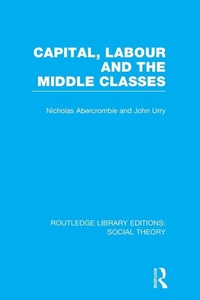
Capital, Labour and the Middle Classes (RLE Social Theory)
1st Edition
Published on 9. December 2015
Book
Paperback/Softback
180 pages
978-1-138-96533-1 (ISBN)
Description
Most recent sociological work on the theory of class is based on a distinction between Weberian and Marxist approaches. For the first part of this volume, the authors use this distinction to review the literature on the middle class, concentrating particularly on the traditions of Marxist theory and of the more empirical work inspired by Max Weber. They show, however, that this distinction is of limited utility in reconstructing a theory of the middle class.
More details
Series
Language
English
Place of publication
London
United Kingdom
Publishing group
Taylor & Francis Ltd
Target group
College/higher education
Dimensions
Height: 234 mm
Width: 156 mm
Thickness: 10 mm
Weight
286 gr
ISBN-13
978-1-138-96533-1 (9781138965331)
Copyright in bibliographic data and cover images is held by Nielsen Book Services Limited or by the publishers or by their respective licensors: all rights reserved.
Schweitzer Classification
Other editions
Additional editions
John Urry | Nicholas Abercrombie
Capital, Labour and the Middle Classes (RLE Social Theory)
E-Book
08/2014
1st Edition
Routledge
€64.49
Available for download
John Urry | Nicholas Abercrombie
Capital, Labour and the Middle Classes (RLE Social Theory)
E-Book
08/2014
1st Edition
Routledge
€64.49
Available for download
John Urry | Nicholas Abercrombie
Capital, Labour and the Middle Classes (RLE Social Theory)
Book
08/2014
1st Edition
Routledge
€159.50
Shipment within 10-20 days
Persons
Content
1. The Problem of the Middle Classes Part 1. Contrasting Approaches to the Middle Classes 2. Some Weberian Theories of the Middle Classes 3. Themes in Weberian Analysis 4. Marxist Approaches 1: Proletarianisation 5. Marxist Approaches 2: Non-Proletarianisation Part 2. Towards a Theory of the Middle Class 6. Unproductive Labour, Knowledge and Credentials 7. Middle Class or Service Class? 8. Causal Powers, Struggles and Politics