

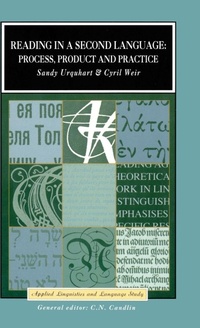
Reading in a Second Language
Process, Product and Practice
1st Edition
Published on 10. July 2016
Book
Hardback
362 pages
978-1-138-14869-7 (ISBN)
Description
Reading in a Second Language sets the testing and teaching of reading against a theoretical background, discussing research from both applied linguistics and cognitive psychology. Where possible, it focuses on research into second language readers and distinguishes different kinds of reading, particularly expeditious as opposed to careful reading, and emphasizes the validity of each.Sandy Urquhart and Cyril Weir relate testing and teaching, discussing similarities and differences, providing a comprehensive survey of both methods with the emphasis on those which have been substantiated or supported by research evidence. Finally, the book proposes specific research topics, and detailed advice on how to construct tests of language for academic purposes and suggestions for further research.
More details
Series
Language
English
Place of publication
London
United Kingdom
Publishing group
Taylor & Francis Ltd
Target group
Professional and scholarly
Dimensions
Height: 222 mm
Width: 145 mm
Thickness: 23 mm
Weight
589 gr
ISBN-13
978-1-138-14869-7 (9781138148697)
Copyright in bibliographic data and cover images is held by Nielsen Book Services Limited or by the publishers or by their respective licensors: all rights reserved.
Schweitzer Classification
Other editions
Additional editions
E-Book
06/2014
1st Edition
Routledge
€69.99
Available for download

E-Book
06/2014
1st Edition
Routledge
€69.99
Available for download
Book
11/1998
1st Edition
Longman
€76.70
Shipment within 10-20 days
Persons
A.H. Urquhart, Cyril J. Weir
Content
PART 1
1. Introduction
2. Preliminaries: What is Reading?PART 2: THE THEORY OF READING
2.1 Models
2.2 Components in Detail
2.3 Comprehension, Skills, Strategies and Styles
2.4 Different Kinds of Reading
PART 3: TESTING READING COMPREHENSION (S)
3.1 Introduction: The Limits of Testing
3.2 Task Based Factors
3.3 Text Based Factors
3.4 Test Formats
3.5 Conclusions
PART 4: THE TEACHING OF READING
4.1 Teaching and Testing?
4.2 Focus on Metacognitive Strategies
4.3 Focus on Cognitive Strategies and Skills
4.4 What Should Happen in the Reading Classroom?
PART 5: FUTURE RESEARCH
5.1 Models and Different Types of Reading
5.2 Reading and the Teaching of Grammar
5.3 The Use of Tests to Investigate Componentiality in Reading Research
1. Introduction
2. Preliminaries: What is Reading?PART 2: THE THEORY OF READING
2.1 Models
2.2 Components in Detail
2.3 Comprehension, Skills, Strategies and Styles
2.4 Different Kinds of Reading
PART 3: TESTING READING COMPREHENSION (S)
3.1 Introduction: The Limits of Testing
3.2 Task Based Factors
3.3 Text Based Factors
3.4 Test Formats
3.5 Conclusions
PART 4: THE TEACHING OF READING
4.1 Teaching and Testing?
4.2 Focus on Metacognitive Strategies
4.3 Focus on Cognitive Strategies and Skills
4.4 What Should Happen in the Reading Classroom?
PART 5: FUTURE RESEARCH
5.1 Models and Different Types of Reading
5.2 Reading and the Teaching of Grammar
5.3 The Use of Tests to Investigate Componentiality in Reading Research