

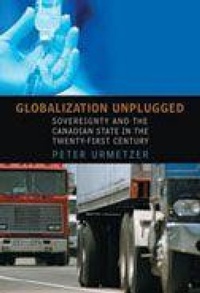
Globalization Unplugged
Sovereignty and the Canadian State in the Twenty-First Century
2nd Edition
Will be published approx. on 17. June 2005
Book
Paperback/Softback
240 pages
978-0-8020-3799-2 (ISBN)
Description
The debate over economic globalization has reached a fever pitch in the past decade and a half with Western governments and multinational corporations trumpeting its virtues and a multitude of activists and developing-world citizens vociferously denouncing it. Both sides would agree that globalization is a recent development that is changing the way people and nations do business, but in Globalization Unplugged, Peter Urmetzer questions whether national economies are losing their sovereignty and whether the topic of globalization merits as much discussion as it receives.
Urmetzer's focus is specifically on Canada and he demonstrates that current levels of trade are not unprecedented and, further, that as the economy becomes more service oriented, it will also become less trade dependent. He points out that only a relatively small percentage of Canada's wealth is owned by foreign investors and likewise, only a small portion of the country's wealth is located outside of its borders.
Disputing claims that the nation-state is weakening or disappearing altogether, Urmetzer shows how the welfare-state side of government spending - conveniently ignored in the anti-globalization literature yet arguably the most significant development in the political economy of the nation-state in the twentieth century - remains remarkable stable. Written with precision and skill, Globalization Unplugged will spark controversy on both sides of the globalization debate and help deflate the rhetoric of both advocates and detractors.
Urmetzer's focus is specifically on Canada and he demonstrates that current levels of trade are not unprecedented and, further, that as the economy becomes more service oriented, it will also become less trade dependent. He points out that only a relatively small percentage of Canada's wealth is owned by foreign investors and likewise, only a small portion of the country's wealth is located outside of its borders.
Disputing claims that the nation-state is weakening or disappearing altogether, Urmetzer shows how the welfare-state side of government spending - conveniently ignored in the anti-globalization literature yet arguably the most significant development in the political economy of the nation-state in the twentieth century - remains remarkable stable. Written with precision and skill, Globalization Unplugged will spark controversy on both sides of the globalization debate and help deflate the rhetoric of both advocates and detractors.
More details
Series
Edition
2nd edition
Language
English
Place of publication
Toronto
Canada
Target group
Professional and scholarly
Product notice
Paperback (trade)
Dimensions
Height: 230 mm
Width: 155 mm
Thickness: 19 mm
Weight
376 gr
ISBN-13
978-0-8020-3799-2 (9780802037992)
Copyright in bibliographic data and cover images is held by Nielsen Book Services Limited or by the publishers or by their respective licensors: all rights reserved.
Schweitzer Classification
Other editions
Additional editions
Peter Urmetzer
Globalization Unplugged
Sovereignty and the Canadian State in the Twenty-First Century
E-Book
07/2005
1st Edition
University of Toronto Press
€80.95
Available for download
Person
Peter Urmetzer is an assistant professor in the Department of Sociology at the University of British Columbia, Okanagan.
Content
Acknowledgments
Introduction
1 The Life and Times of Globalization: An Unauthorized Biography
2 Marx, Globalization, and Modernity:What Is Old Becomes New Again
3 The World Economy
4 Trade
5 Foreign Direct Investment
6 The Financial Economy
7 The Retreat of the Nation-state
8 The Postwar Economy
Conclusion
Appendix: Note on Statistical Sources
Notes
Bibliography
Index
Introduction
1 The Life and Times of Globalization: An Unauthorized Biography
2 Marx, Globalization, and Modernity:What Is Old Becomes New Again
3 The World Economy
4 Trade
5 Foreign Direct Investment
6 The Financial Economy
7 The Retreat of the Nation-state
8 The Postwar Economy
Conclusion
Appendix: Note on Statistical Sources
Notes
Bibliography
Index