

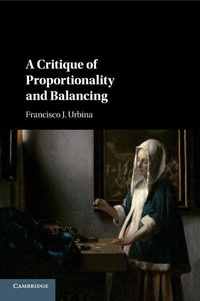
A Critique of Proportionality and Balancing
Published on 21. June 2018
Book
Paperback/Softback
280 pages
978-1-316-62681-8 (ISBN)
Description
The principle of proportionality, which has become the standard test for adjudicating human and constitutional rights disputes in jurisdictions worldwide has had few critics. Proportionality is generally taken for granted or enthusiastically promoted or accepted with minor qualifications. A Critique of Proportionality and Balancing presents a frontal challenge to this orthodoxy. It provides a comprehensive critique of the proportionality principle, and particularly of its most characteristic component, balancing. Divided into three parts, the book presents arguments against the proportionality test, critiques the view of rights entailed by it, and proposes an alternative understanding of fundamental rights and their limits.
More details
Language
English
Place of publication
Cambridge
United Kingdom
Target group
Professional and scholarly
Product notice
Paperback (trade)
Dimensions
Height: 229 mm
Width: 152 mm
Thickness: 16 mm
Weight
410 gr
ISBN-13
978-1-316-62681-8 (9781316626818)
Copyright in bibliographic data and cover images is held by Nielsen Book Services Limited or by the publishers or by their respective licensors: all rights reserved.
Schweitzer Classification
Other editions
Additional editions
Francisco J. Urbina
A Critique of Proportionality and Balancing
Book
01/2017
Cambridge University Press
€143.40
Shipment within 15-20 days
Person
Francisco J. Urbina is Assistant Professor of Law at Pontificia Universidad Catolica de Chile. His research focuses on human rights, legal reasoning, and public law.
Content
1. Introduction; Part I: 2. The maximisation account of proportionality; 3. The incommensurability objection; 4. Why proportionality?; 5. Proportionality, rights, and legitimate interests; Part II: 6. Proportionality as unconstrained moral reasoning; 7. The need for legal direction in adjudication; 8. Proportionality and the problems of legally unaided adjudication; Part III: 9. Legal human rights.