

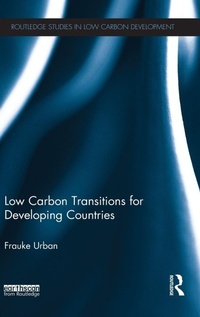
Low Carbon Transitions for Developing Countries
1st Edition
Published on 11. June 2014
Book
Hardback
200 pages
978-0-415-65700-6 (ISBN)
Description
Global climate change is one of the greatest challenges of our times and in order to tackle this carbon emissions need to be mitigated. China and India have recently become some of the world's largest greenhouse gas emitters. Transitions to low carbon energy, for reducing emissions that lead to climate change, are therefore an urgent priority for China and India and at a global level.
This is the first book focusing on low carbon energy transitions for emerging economies such as China and India, assessing the opportunities and barriers for transitions to renewable and low carbon energy as climate change mitigation options. It uses energy modelling to assess the China's power sector, the economy of Beijing and rural Indian households that do not have access to electricity. The research evaluates the environmental, technical, socio-economic and policy implications of these low carbon transitions, concluding that they are possible in China and India and they can considerably contribute to climate change mitigation.
This interdisciplinary book will be of interest to scholars, students, practitioners and policy-makers working in the fields of energy and development, energy policy, energy studies and modelling, climate policy, climate change mitigation, climate change and development, low carbon development, sustainable development, environment and development and environmental management.
This is the first book focusing on low carbon energy transitions for emerging economies such as China and India, assessing the opportunities and barriers for transitions to renewable and low carbon energy as climate change mitigation options. It uses energy modelling to assess the China's power sector, the economy of Beijing and rural Indian households that do not have access to electricity. The research evaluates the environmental, technical, socio-economic and policy implications of these low carbon transitions, concluding that they are possible in China and India and they can considerably contribute to climate change mitigation.
This interdisciplinary book will be of interest to scholars, students, practitioners and policy-makers working in the fields of energy and development, energy policy, energy studies and modelling, climate policy, climate change mitigation, climate change and development, low carbon development, sustainable development, environment and development and environmental management.
More details
Series
Language
English
Place of publication
London
United Kingdom
Publishing group
Taylor & Francis Ltd
Target group
College/higher education
Illustrations
39 s/w Abbildungen, 39 s/w Zeichnungen, 21 s/w Tabellen
21 Tables, black and white; 39 Line drawings, black and white; 39 Illustrations, black and white
Dimensions
Height: 240 mm
Width: 161 mm
Thickness: 15 mm
Weight
470 gr
ISBN-13
978-0-415-65700-6 (9780415657006)
Copyright in bibliographic data and cover images is held by Nielsen Book Services Limited or by the publishers or by their respective licensors: all rights reserved.
Schweitzer Classification
Other editions
Additional editions
Frauke Urban
Low Carbon Transitions for Developing Countries
Book
05/2016
1st Edition
Routledge
€71.50
Shipment within 10-20 days
Frauke Urban
Low Carbon Transitions for Developing Countries
E-Book
06/2014
1st Edition
Routledge
€64.49
Available for download
Frauke Urban
Low Carbon Transitions for Developing Countries
E-Book
06/2014
1st Edition
Routledge
€64.49
Available for download
Person
Frauke Urban is a Lecturer in Environment and Development at the Centre for Development, Environment and Policy CeDEP at the School of Oriental and African Studies SOAS at the University of London, UK.
Content
1. General Introduction 2. Modelling Energy and Development: an evaluation of models and concepts 3. Modelling Energy Systems for Developing Countries 4. Renewable and Low Carbon Energy as Mitigation Options of Climate Change for China's Power Sector 5. Scenarios for Renewable Energy Transitions in Beijing 6. Energy for Rural India 7. Conclusions