

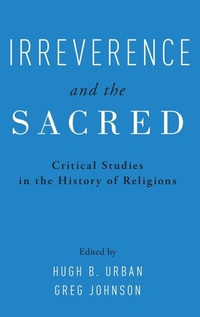
Irreverence and the Sacred
Critical Studies in the History of Religions
Published on 21. December 2018
Book
Hardback
350 pages
978-0-19-091196-6 (ISBN)
Description
Irreverence and the Sacred brings together some of the most cutting edge, interdisciplinary, and international scholars working today in order to debate key issues in the critical and comparative study of religion. The project is inspired in large part by the work of Bruce Lincoln, whose influential and wide-ranging scholarship has consistently posed challenging, provocative, and often-irreverent questions that have really pushed the boundaries of the field of religious studies in important, sometimes controversial ways. Retracing the history of the discipline of religious studies, Lincoln argues that the field has tended to champion a "validating, feel-good" approach to religion, rather than posing more critical questions about religious claims to authority and their role in history, politics, and social change. A critical approach to the history of religions, he suggests, would focus on the human, temporal, and material aspects of phenomena that are claimed to have a superhuman, eternal, or transcendent status. This volume takes up Lincoln's challenge to "do better," by engaging in critical analyses of four key themes in the study of religion: myth, ritual, gender, and politics. The book also interrogates the "politics of scholarship" itself, critically examining the relations of power and material interests at work in the study as well as the practice of religion. The scholars involved in this project include not only some of the most important figures in the American study of religion--such as Wendy Doniger, Russell McCutcheon, Ivan Strenski, and Lincoln himself--but also European scholars whose work is hugely influential overseas but not as well known in the U.S.--such as Stefan Arvidsson, Claude Calame, Nicolas Meylan, and others.
Reviews / Votes
... these provocative essays constitute a fine, thoughtful, and original treatment. Summing up: Recommended * CHOICE * Bruce Lincoln's razor-sharp, lightning strike essays are a pleasure to read and re-read... s. Irreverence and the Sacred is therefore required reading for all those who take Lincoln's vision of the history of religions seriously. * Brian Collins, Ohio University, Religious Studies Review * Irreverence and the Sacred offers fresh perspectives on one of the most influential theorists in religious studies. The book also contains deeply self-conscious explorations of how scholars of religion approach their work; the authors describe the processes they use in specific projects and the dilemmas they have faced while conducting their research. On occasion authors in this volume even express regret that perhaps they could have approached particular projects differently. This process of self-description and reflection on the part of the authors unifies this book far more than any field of study or response to specific writings of Lincoln. It is the insight into this grappling on how to best conduct scholarly work and the application of religious studies theory to such a wide variety of subjects that make this such an immensely valuable resource. * Melody Everest, Reading Religion *More details
Language
English
Place of publication
New York
United States
Target group
College/higher education
Professional and scholarly
Dimensions
Height: 240 mm
Width: 161 mm
Thickness: 23 mm
Weight
690 gr
ISBN-13
978-0-19-091196-6 (9780190911966)
Copyright in bibliographic data and cover images is held by Nielsen Book Services Limited or by the publishers or by their respective licensors: all rights reserved.
Schweitzer Classification
Other editions
Additional editions
E-Book
11/2018
OUP eBook
€40.49
Available for download
E-Book
11/2018
OUP eBook
€52.49
Available for download
Persons
Hugh B. Urban is a professor of religious studies and South Asian studies in the Department of Comparative Studies at Ohio State University. He is the author of nine books, including The Church of Scientology: A History of a New Religion (2011) and Zorba the Buddha: Sex, Spirituality and Capitalism in the Global Osho Movement (2016).
Greg Johnson is Associate Professor of Religious Studies and Director of the Center for Native American and Indigenous Studies at the University of Colorado, Boulder. He is the author of Sacred Claims: Repatriation and Living Tradition and co-editor of Handbook of Indigenous Religion(s) (2017).
Greg Johnson is Associate Professor of Religious Studies and Director of the Center for Native American and Indigenous Studies at the University of Colorado, Boulder. He is the author of Sacred Claims: Repatriation and Living Tradition and co-editor of Handbook of Indigenous Religion(s) (2017).
Content
Contributors
List of Images
Preface and Acknowledgements
INTRODUCTION
Destabilizing the Sacred: A Critical History of Religions
Hugh B. Urban and Greg Johnson
PART I. MYTH AND NARRATIVE
1. (Mythical) Battles in Medieval Scandinavia: Battle Narratives and the
Construction of Society
Nicolas Meylan
2. Myth, Third Rome, and the Uses of Ressentiment: An Essay in Myth Criticism
Ivan Strenski
3. How the Arthashastra and the Kamasutra Got Away With Their Critiques of
Dharma
Wendy Doniger
4. Authority Apart from Truth: Superhero Comic Book Stories as Myth
Kevin Wanner
5. Myths and Utopias, Critics and Caretakers: In Defense of Revisionist History
Stefan Arvidsson
PART II. RITUAL AND PRACTICE
6. Ritual, Advocacy, and Authority: The Challenge of Being an Irreverent Witness
Greg Johnson
7. Death, Nationalism, and Sacrifice: Ritual, Violence, Politics, and Tourism in
Northeast India
Hugh B. Urban
8. Becoming Zarathustra
Jean Kellens
PART III. GENDER AND SEXUALITY
9. Where Men are Knights and Women are Princesses: Gender Ideology in Brazil's Valley of the Dawn
Kelly E. Hayes
10. Straightening Out the Gods' Gender
Kathleen Self
11. Norn, Vampire, Female Christ: Myth and Myth-Making in Sweden's First
Feminist Novel
Stefanie von Schnurbein
PART IV. POWER, POLITICS, AND THE POLITICS OF SCHOLARSHIP
12. Historicizing the Elephant in the Room
Russell T. McCutcheon
13. What is Religion? Between Christocentric Paradigm and Anthropological Relativism
Claude Calame
14. Rereading Charlie Hebdo: Of Irreverence and Laicite
S. Romi Mukherjee
Afterword: An Interview with Bruce Lincoln on Religion, Comparison, and the Politics of Scholarship
Index
List of Images
Preface and Acknowledgements
INTRODUCTION
Destabilizing the Sacred: A Critical History of Religions
Hugh B. Urban and Greg Johnson
PART I. MYTH AND NARRATIVE
1. (Mythical) Battles in Medieval Scandinavia: Battle Narratives and the
Construction of Society
Nicolas Meylan
2. Myth, Third Rome, and the Uses of Ressentiment: An Essay in Myth Criticism
Ivan Strenski
3. How the Arthashastra and the Kamasutra Got Away With Their Critiques of
Dharma
Wendy Doniger
4. Authority Apart from Truth: Superhero Comic Book Stories as Myth
Kevin Wanner
5. Myths and Utopias, Critics and Caretakers: In Defense of Revisionist History
Stefan Arvidsson
PART II. RITUAL AND PRACTICE
6. Ritual, Advocacy, and Authority: The Challenge of Being an Irreverent Witness
Greg Johnson
7. Death, Nationalism, and Sacrifice: Ritual, Violence, Politics, and Tourism in
Northeast India
Hugh B. Urban
8. Becoming Zarathustra
Jean Kellens
PART III. GENDER AND SEXUALITY
9. Where Men are Knights and Women are Princesses: Gender Ideology in Brazil's Valley of the Dawn
Kelly E. Hayes
10. Straightening Out the Gods' Gender
Kathleen Self
11. Norn, Vampire, Female Christ: Myth and Myth-Making in Sweden's First
Feminist Novel
Stefanie von Schnurbein
PART IV. POWER, POLITICS, AND THE POLITICS OF SCHOLARSHIP
12. Historicizing the Elephant in the Room
Russell T. McCutcheon
13. What is Religion? Between Christocentric Paradigm and Anthropological Relativism
Claude Calame
14. Rereading Charlie Hebdo: Of Irreverence and Laicite
S. Romi Mukherjee
Afterword: An Interview with Bruce Lincoln on Religion, Comparison, and the Politics of Scholarship
Index