

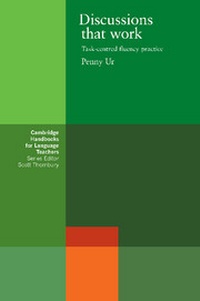
Discussions that Work
Task-centred Fluency Practice
Published on 30. January 1981
Book
Paperback/Softback
130 pages
978-0-521-28169-0 (ISBN)
Description
How can you make a discussion really work? What sort of activities produce genuine and enthusiastic exchanges of ideas? How can you prepare such exercises quickly and easily? These are some of the questions that Discussions that Work sets out to answer. The first part provides some general guidelines on the organisation of successful task-centred activities. The second part consists of some fifty practical examples which have been tried and found effective in the classroom. They range from fairly simple to complex and sophisticated, and can thus be used with a wide range of learners, from elementary to the most advanced, in both secondary and adult education.
Reviews / Votes
'Penny Ur writes lucidly and sensibly, emphasizing that in the classroom why you need to talk about something is more important than what you should talk about.' Donald Hawes, The Times Educational Supplement ' ... has a wealth of practical ideas which can be used in the classroom tomorrow.' Wendy Scott, Practical English TeachingMore details
Series
Language
English
Place of publication
Cambridge
United Kingdom
Target group
ELT/ESL
Product notice
Paperback (trade)
Dimensions
Height: 228 mm
Width: 152 mm
Thickness: 8 mm
Weight
218 gr
ISBN-13
978-0-521-28169-0 (9780521281690)
Copyright in bibliographic data and cover images is held by Nielsen Book Services Limited or by the publishers or by their respective licensors: all rights reserved.
Schweitzer Classification
Other editions
New editions
Book
11/2014
2nd Edition
Cambridge University Press
€82.00
Shipment within 15-20 days
Person
fm.author_biographical_note1
Content
Preface; Part I. General Principles: 1. What is a discussion?; 2. Some factors in a good discussion: topic, group-work, role-play; 3. Giving the discussion a purpose: the task; 4. Organization; Part II. Practical Examples: 5. Introduction; 6. Brainstorming activities; 7. Organizing activities; 8. Compound activities; Bibliography; Index.