

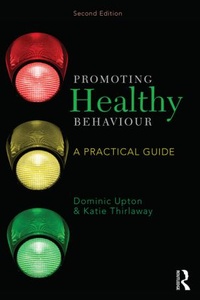
Promoting Healthy Behaviour
A Practical Guide
2nd Edition
Published on 10. February 2014
Book
Paperback/Softback
384 pages
978-1-4479-2136-3 (ISBN)
Description
There is ever growing recognition by governments and healthcare professionals of the need to respond to the challenges of preventable diseases, especially so-called "lifestyle diseases", and of the influence that social class, gender, ethnicity, as well as individual differences play in health. This text explores the fundamental importance of psychology in the development of these lifestyle diseases, and how an understanding of psychological models is essential for the healthcare practitioner to predict behaviours and develop evidence-based interventions.
This thoroughly updated edition includes new chapters looking at health inequalities, health promotion, working with special populations and understanding the role of social and psychological factors in some common conditions. These four additional chapters will enable the reader to better understand the place of lifestyle change within wider society. Beginning with an introduction to healthy behaviour and the context that health practitioners work in, the book goes on to look at issues, including:
The role of psychology in lifestyle change
Diet, alcohol, smoking and active lifestyles
Sexual behaviour
Chronic illness and vulnerable populations.
Each chapter includes key features including learning objectives, case studies, key points and discussion questions, as well as how to apply the various research and theories to practice. Promoting Healthy Behaviour is a practical and informative guide for your practice both now and in the future, and is invaluable reading for healthcare professionals at any stage of their careers.
This thoroughly updated edition includes new chapters looking at health inequalities, health promotion, working with special populations and understanding the role of social and psychological factors in some common conditions. These four additional chapters will enable the reader to better understand the place of lifestyle change within wider society. Beginning with an introduction to healthy behaviour and the context that health practitioners work in, the book goes on to look at issues, including:
The role of psychology in lifestyle change
Diet, alcohol, smoking and active lifestyles
Sexual behaviour
Chronic illness and vulnerable populations.
Each chapter includes key features including learning objectives, case studies, key points and discussion questions, as well as how to apply the various research and theories to practice. Promoting Healthy Behaviour is a practical and informative guide for your practice both now and in the future, and is invaluable reading for healthcare professionals at any stage of their careers.
Reviews / Votes
"Health promotion is more important than ever and this book is an informative and practical companion for nurses that provides a solid foundation to help them to help their patients change their lifestyles for the better." - Grant Byrne, Nursing Standard, Vol. 28 No. 52, August 27 "Health promotion is more important than ever and this book is an informative and practical companion for nurses that provides a solid foundation to help them to help their patients change their lifestyles for the better." - Grant Byrne, Nursing Standard, Vol. 28 No. 52, August 27"A key strength of this book is the robust evidence base provided without making the text dry or academic. I found it to be an engaging page-turner with answers to a lot of the practical questions health promotion throws up for health practitioners on a daily basis when dealing with patients and planning health promotion strategies. This book excels in demonstrating how all health practitioners can utilize the cognitive-behavioural approach in everyday practice by understanding the psychology of patients to try and nudge their key health behaviours in the right direction. The authors have clearly spent a lot of time engaging with health professionals and understanding their psychology to approaching these topics in clinical practice, in addition to tailoring the book to concisely reflect their comprehensive research in this area. This book succeeds in the stated aim of providing a practical and informative guide for the healthcare practitioners on a topic that now impacts the entire population, directly or indirectly. It does equip the occupational health professional with the knowledge and tools to persuade organizations, colleagues and patients to prioritize addressing health behaviours in a subtler and more effective manner, both in consultations and in designing health promotion campaigns. It is certainly worth an occupational health department purchasing a text which will provide numerous intangible benefits for the healthcare practitioners and the patients they interact with." - Occupational Medicine
More details
Edition
2nd edition
Language
English
Place of publication
Harlow
United Kingdom
Target group
College/higher education
Professional and scholarly
Illustrations
1 s/w Photographie bzw. Rasterbild, 24 s/w Zeichnungen, 74 s/w Tabellen
74 Tables, black and white; 24 Line drawings, black and white; 1 Halftones, black and white
Dimensions
Height: 246 mm
Width: 174 mm
Weight
657 gr
ISBN-13
978-1-4479-2136-3 (9781447921363)
Schweitzer Classification
Other editions
New editions
Dominic Upton | Katie Thirlaway
Promoting Healthy Behaviour
A Practical Guide to Physical Health and Mental Wellbeing
Book
04/2024
3rd Edition
Routledge
€58.30
Shipment within 10-20 days
Additional editions
Book
02/2014
2nd Edition
Routledge
€245.12
Article exhausted; check for reprint
Persons
Dominic Upton is Professor of Health Psychology at the University of Worcester, UK.
Katie Thirlaway is Head of Applied Psychology at Cardiff Metropolitan University, UK.
Katie Thirlaway is Head of Applied Psychology at Cardiff Metropolitan University, UK.
Content
1. Introduction to Healthy Behaviour 2. Health Promotion, Health Education and Public Health 3. Health and Health Inequalities 4. Psychology in Practice 5. Eating Well 6. Being Active 7. Sensible Drinking 8. Quitting Smoking 9. Safer Sex 10. Specific Conditions 11. Special Populations 12. Conclusion