

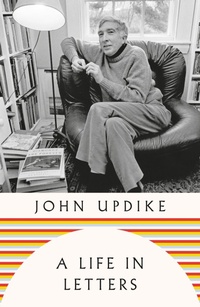
A Life in Letters
Published on 6. November 2025
Book
Hardback
912 pages
978-0-241-70758-6 (ISBN)
Description
The arc of literary giant John Updike's life emerges in these luminous daily letters to family, friends, editors, and lovers - a remarkable outpouring over six decades, from his earliest consciousness as a writer to his final days
In the words of his contemporary, Philip Roth, John Updike was 'Our time's greatest man of letters - as brilliant a literary critic and essayist as he was a novelist and short-story writer'.
Over the course of his long and immensely productive career, he also proved himself a brilliant correspondent, his letters filled with comic observations, opinions and personal news, told in his characteristically elegant and exquisitely fluid style.
In this sparkling selection of his letters, edited by James Schiff, we can see Updike in real time, capturing every stage of his unspooling life, from Pennsylvania farm boy to Pulitzer prizewinner; and from young father negotiating his first book contract to the bestselling writer he became, following the international success of his novels Couples and the 'Rabbit 'sequence.
Here are letters to family, friends, editors and lovers, a remarkable outpouring over six decades - including, most movingly perhaps, the letters of his final year bidding farewell to children, colleagues and friends.
Taken together, these missives make a page-turning 'life in letters' like no other - an intimate testament to one of the greatest of all American writers.
'Nobody has a better understanding of the capriciousness of the human heart than John Updike' Daily Telegraph
'He was the ideal son of a platonic union between John Cheever and J.D. Salinger, with Nabokov attending the christening as fairy godfather' James Wood
'John Updike mapped our desires, our wishes, our wise and unwise dreams, our uncertainties, with such elegant precision and for so many years' The Times
In the words of his contemporary, Philip Roth, John Updike was 'Our time's greatest man of letters - as brilliant a literary critic and essayist as he was a novelist and short-story writer'.
Over the course of his long and immensely productive career, he also proved himself a brilliant correspondent, his letters filled with comic observations, opinions and personal news, told in his characteristically elegant and exquisitely fluid style.
In this sparkling selection of his letters, edited by James Schiff, we can see Updike in real time, capturing every stage of his unspooling life, from Pennsylvania farm boy to Pulitzer prizewinner; and from young father negotiating his first book contract to the bestselling writer he became, following the international success of his novels Couples and the 'Rabbit 'sequence.
Here are letters to family, friends, editors and lovers, a remarkable outpouring over six decades - including, most movingly perhaps, the letters of his final year bidding farewell to children, colleagues and friends.
Taken together, these missives make a page-turning 'life in letters' like no other - an intimate testament to one of the greatest of all American writers.
'Nobody has a better understanding of the capriciousness of the human heart than John Updike' Daily Telegraph
'He was the ideal son of a platonic union between John Cheever and J.D. Salinger, with Nabokov attending the christening as fairy godfather' James Wood
'John Updike mapped our desires, our wishes, our wise and unwise dreams, our uncertainties, with such elegant precision and for so many years' The Times
Reviews / Votes
One of the greatest American writers of the 20th century . . . Brilliant, riveting and essential for anyone remotely interested in Updike; shockingly salacious enough to enthral the remotely curious; and cleverly annotated for easy reading . . . The best letters are those to his wives in the 1970s, where you realise that Updike's greatness as a writer lies not in his much-lauded descriptive powers, nor in his ability to weave arcane areas of computer science or theology into his fiction, but in his ruthlessly honest psychological acuity, as he lays himself bare - right down to admitting he likes to beat his wife's lover at golf * The Times * Magnificent, evocative . . . A profoundly poignant portrait, an invaluable historical document, and a timely reflection on the eternal tensions between societal conventions and free speech . . . Done this well, epistolary biography comes to seem the best and most honorable kind * The Telegraph * The book's editor James Schiff's footnotes provide illuminating context and help to bring Updike and his world charging into the present with such force that, at times, it is difficult to accept that the man who wrote these letters is dead . . . Updike was a prodigious correspondent but this selection is also a paean to the vanishing art of letter writing. Will such a book be possible in the future? A dashed off email is not going to reveal a personality as vividly, no matter who writes it. Updike would not have accepted a sombre ending so I'll just say his letters are gold, shining with insights about literature and life, and an opportunity to hear his voice as clearly as anywhere else in his oeuvre * Financial Times * What an enormous and beneficent bounty these letters are for anyone who cares about [American] literature during the last half century . . . Come for the gossip . . . Come for the love letters . . . Come to watch him cope with the aftermath of fame . . . Updike's letters sing because he cared so intensely about getting the words right * New York Times * Wonderfully copious . . . Updike simply had it: an instinctive feeling for the shape of American sentences, for the murmuring music of nouns and verbs and the way they could pin reality to the page * New Statesman * John Updike had the mind of a middling middle-class postwar American male, and the prose style of a literary genius . . . Friends, enemies and lovers animate more than 60 years of the author's remarkable correspondence . . . John Updike, the man incapable of writing a bad sentence * Guardian * The letters and postcards (Updike loved a postcard) contain more than just pretty phrases. He talked shop - the writing, reading and manufacture of books - but also engaged in brave and sometimes anguished explorations of ambition, lust, love, guilt and shame * The Spectator * An epistolary account of much of Updike's life, which follows him through childhood, college, his literary career, his relationship with this magazine, his two marriages, fatherhood, multiple affairs, and more. The result is an inadvertent self-portrait, written with wit and grace. Updike maintains a certain ebullient positivity, even in his darker moments * The New Yorker * [Updike's letters] have the repleteness of his fiction, the springy, unexpected notice of the smallest particulars. This huge volume is readable in a way that too many collections of writers' letters, however useful to scholarly research, simply are not. Lovely flourishes remind us of Updike's talent for light verse . . . [his] tenderness, a natural instinct for conciliation, always re-emerges . . . These letters make plain [his] ability to marvel and thank [and the] willingness to take America to his bosom . . . that guarantees his permanent place in this country's literature * Wall Street Journal * In the aggregate, Updike's letters could constitute the outline for a never-published Updike novel . . . Updike is, as ever, captivating on the page * The Atlantic *More details
Language
English
Place of publication
London
United Kingdom
Publishing group
Penguin Books Ltd
Dimensions
Height: 242 mm
Width: 169 mm
Thickness: 62 mm
Weight
1196 gr
ISBN-13
978-0-241-70758-6 (9780241707586)
Copyright in bibliographic data and cover images is held by Nielsen Book Services Limited or by the publishers or by their respective licensors: all rights reserved.
Schweitzer Classification
Other editions
Additional editions
Person
John Updike was born in 1932 in Shillington, Pennsylvania. He is the author of over fifty books, including The Poorhouse Fair; the Rabbit series (Rabbit, Run; Rabbit Redux; Rabbit Is Rich; Rabbit At Rest); Marry Me; The Witches of Eastwick, which was made into a major feature film; Memories of the Ford Administration; Brazil; In the Beauty of the Lilies; Toward the End of Time; Gertrude and Claudius; and Seek My Face. He has written a number of collections of short stories, including The Afterlife and Other Stories and Licks of Love, which includes a final Rabbit story, Rabbit Remembered. His essays and criticism first appeared in publications such as the New Yorker and the New York Review of Books, and are now collected into numerous volumes. Collected Poems 1953-1993 brings together almost all of his verse, and a new edition of his Selected Poems is forthcoming from Hamish Hamilton.
His novels, stories, and non-fiction collections have won have won the Pulitzer Prize, the National Book Award, the PEN/Faulkner Award, the American Book Award, the National Book Critics Circle Award, the Rosenthal Award and the Howells Medal.
Updike graduated from Harvard College in 1954, and spent a year at Oxford's Ruskin School of Drawing and Fine Art. From 1955 to 1957 he was a member of staff at the New Yorker, and he lived in Massachusetts from 1957 until his death in January 2009.
His novels, stories, and non-fiction collections have won have won the Pulitzer Prize, the National Book Award, the PEN/Faulkner Award, the American Book Award, the National Book Critics Circle Award, the Rosenthal Award and the Howells Medal.
Updike graduated from Harvard College in 1954, and spent a year at Oxford's Ruskin School of Drawing and Fine Art. From 1955 to 1957 he was a member of staff at the New Yorker, and he lived in Massachusetts from 1957 until his death in January 2009.