

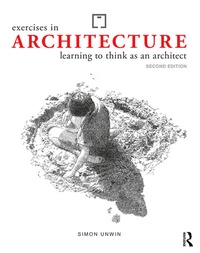
Exercises in Architecture
Learning to Think as an Architect
2nd Edition
Published on 1. August 2022
Book
Hardback
230 pages
978-1-032-26566-7 (ISBN)
Description
This revised edition of Exercises in Architecture: Learning to Think as an Architect is full of new content, building on the success of the previous edition. All the original exercises have been revised and new ones added, with the format changing to allow the inclusion of more supplementary material. The aim remains the same, to help pre- or early-course architecture students begin and develop their ability to think as architects.
Learning to do architecture is tricky. It involves awakening abilities that remain dormant in most people. It is like learning language for the first time; a task made more mystifying by the fact that architecture deals not in words but in places: places to stand, to walk, to sit, to hide, to sleep, to cook, to eat, to work, to play, to worship...
This book was written for those who want to be architects. It suggests a basis for early experiences in a school of architecture; but it could also be used in secondary schools and colleges, or as self-directed preparation for students in the months before entering professional education.
Exercises in Architecture builds on and supplements the methodology for architectural analysis presented in the author's previous book Analysing Architecture: the Universal Language of Place-Making (fifth edition, 2021) and demonstrated in his Twenty-Five Buildings Every Architect Should Understand (Routledge, 2015). Together, the three books, deal with the three aspects of learning any creative discipline: 1. Analysing Architecture provides a methodology for analysis that develops an understanding of the way architecture works; 2. Twenty-Five Buildings explores and extends that methodology through analysis of examples as case studies; and 3. Exercises in Architecture offers a way of expanding understanding and developing fluency by following a range of rudimentary and more sophisticated exercises.
Those who wish to become professional architects (wherever in the world they might be) must make a conscious effort to learn the universal language of architecture as place-making, to explore its powers and how they might be used. The exercises in this book are designed to help.
Learning to do architecture is tricky. It involves awakening abilities that remain dormant in most people. It is like learning language for the first time; a task made more mystifying by the fact that architecture deals not in words but in places: places to stand, to walk, to sit, to hide, to sleep, to cook, to eat, to work, to play, to worship...
This book was written for those who want to be architects. It suggests a basis for early experiences in a school of architecture; but it could also be used in secondary schools and colleges, or as self-directed preparation for students in the months before entering professional education.
Exercises in Architecture builds on and supplements the methodology for architectural analysis presented in the author's previous book Analysing Architecture: the Universal Language of Place-Making (fifth edition, 2021) and demonstrated in his Twenty-Five Buildings Every Architect Should Understand (Routledge, 2015). Together, the three books, deal with the three aspects of learning any creative discipline: 1. Analysing Architecture provides a methodology for analysis that develops an understanding of the way architecture works; 2. Twenty-Five Buildings explores and extends that methodology through analysis of examples as case studies; and 3. Exercises in Architecture offers a way of expanding understanding and developing fluency by following a range of rudimentary and more sophisticated exercises.
Those who wish to become professional architects (wherever in the world they might be) must make a conscious effort to learn the universal language of architecture as place-making, to explore its powers and how they might be used. The exercises in this book are designed to help.
Reviews / Votes
'One of those books I wish I had come across when I was studying design. It's a wonderful educational endeavour.' Michael Andersson, Amazon.co.uk'Great book by a great author.' jgfw, Amazon.com
More details
Edition
2nd edition
Language
English
Place of publication
London
United Kingdom
Publishing group
Taylor & Francis Ltd
Target group
College/higher education
Postgraduate, Undergraduate, Undergraduate Advanced, and Undergraduate Core
Illustrations
883 s/w Abbildungen, 122 s/w Photographien bzw. Rasterbilder, 761 s/w Zeichnungen
761 Line drawings, black and white; 122 Halftones, black and white; 883 Illustrations, black and white
Dimensions
Height: 276 mm
Width: 219 mm
Weight
1160 gr
ISBN-13
978-1-032-26566-7 (9781032265667)
Copyright in bibliographic data and cover images is held by Nielsen Book Services Limited or by the publishers or by their respective licensors: all rights reserved.
Schweitzer Classification
Other editions
Additional editions
Book
08/2022
2nd Edition
Routledge
€42.50
Shipment within 10-20 days
E-Book
08/2022
2nd Edition
Routledge
€44.99
Available for download
Previous edition
Book
01/2012
1st Edition
Routledge
€237.70
Article exhausted; check for reprint
Person
Simon Unwin is Emeritus Professor of Architecture at the University of Dundee, Scotland. He has lived in Great Britain and Australia, and taught or lectured on his work in China, Israel, India, Sweden, Turkey and the United States. Analysing Architecture's international relevance is indicated by its translation into various languages and its adoption for architecture courses around the world. Now retired, Simon Unwin continues to teach at The Welsh School of Architecture in Cardiff, UK.
Content
Prelude: the essence of architecture Introduction Section 1: fundamentals Exercise 1: the substance without substance Exercise 2: flipping perceptions Exercise 3: axis (and its denial) Exercise 4: doorway places Section 2: geometry Exercise 5: alignment Exercise 6: anthropometry Exercise 7: social geometry Exercise 8: geometry of making Exercise 9: geometry of planning Exercise 10: ideal geometry Exercise 11: axial symmetry Exercise 12: playing with geometry Section 3: out into the real world Exercise 13: making places in the landscape Exercise 14: making places just by being Exercise 15: geometry of making Exercise 16: responding to conditions Exercise 17: framing atmospheres Exercise 18: measured drawing Exercise 19: setting down space-time rules Section 4: additional exercises Exercise 20: place descriptions in literature Exercise 21: architecture without sight Exercise 21: eliciting an emotional response Exercise 22: framing Acknowledgements Bibliography Index