

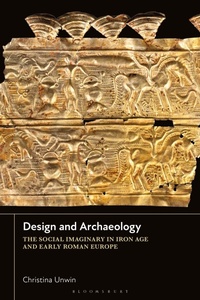
Design and Archaeology
The Social Imaginary in Iron Age and Early Roman Europe
Will be published approx. on 8. January 2026
Book
Hardback
296 pages
978-1-350-44384-6 (ISBN)
Description
The application of design practice and theory has received little attention in the field of archaeology, despite the close and interdisciplinary connection of both disciplines working with material culture. Christina Unwin provides an up-to-date study that addresses this lacuna, by using a series of case studies from the Iron Age and early Roman period (c. 600 BC - c. AD 200) in different European regions. Giving the reader a concise overview of the relevant terminology and approaches in design theory, Unwin then applies these treatments in different archaeological contexts to reveal new aspects of how we can understand material culture.
Design theory reveals that a material object may be understood beyond its material, form, function and period of time in which it was made, and invites archaeologists to re-evaluate their approaches to material things from a completely new perspective. Designed and made objects are immaterial in their planning, associations and effects - as well as material in their physical presence. The conceptual and terminological boundaries set by archaeological studies may therefore be challenged through the idea of design. This, in turn, enables the archaeologist to reconnect objects in terms of the people who made them, how they used them and how they interacted with them to build their sociality. This book is a significant intervention in the exploration of design and archaeological intersections across material culture.
Design theory reveals that a material object may be understood beyond its material, form, function and period of time in which it was made, and invites archaeologists to re-evaluate their approaches to material things from a completely new perspective. Designed and made objects are immaterial in their planning, associations and effects - as well as material in their physical presence. The conceptual and terminological boundaries set by archaeological studies may therefore be challenged through the idea of design. This, in turn, enables the archaeologist to reconnect objects in terms of the people who made them, how they used them and how they interacted with them to build their sociality. This book is a significant intervention in the exploration of design and archaeological intersections across material culture.
Reviews / Votes
Unwin's volume provides an exciting new way of thinking about Iron Age and Roman identities though an original approach using design theory. Her challenge to archaeologists to re-assess the ways they examine material culture and concepts of design represents a new 'way of seeing'. -- Tom Moore, Professor of Archaeology, Durham University, UK A timely and adroit publication which explores the relational complexity and evolving histories of Early Roman and Iron Age objects and their archaeologies. -- Grant Pooke, Former Head of Design, University of Gloucestershire, UK For archaeologists working on European Celtic Art, this book opens a fresh perspective and encourages rethinking the categories in which we often press these amazing objects. It forces us instead to think about the processes and intentions behind the making of these things and the people behind these processes. -- Tanja Romankiewicz, Chancellor's Fellow and Lecturer in Archaeology, University of Edinburgh, UKMore details
Language
English
Place of publication
London
United Kingdom
Publishing group
Bloomsbury Publishing PLC
Target group
Professional and scholarly
Illustrations
52 bw illus
Dimensions
Height: 240 mm
Width: 161 mm
Thickness: 20 mm
Weight
605 gr
ISBN-13
978-1-350-44384-6 (9781350443846)
Copyright in bibliographic data and cover images is held by Nielsen Book Services Limited or by the publishers or by their respective licensors: all rights reserved.
Schweitzer Classification
Person
Christina Unwin is a graphic designer, illustrator and archaeologist based in the UK. She is a graduate in archaeology from University College London and a postgraduate in design from the London College of Printing. She is the co-author of Boudica: Iron Age Warrior Queen (Bloomsbury Academic, 2006) and illustrator of Londinium: A Biography (Bloomsbury Academic, 2018).
Content
List of Illustrations
Acknowledgements
Foreword Michael Shanks
1. Introduction
2. Defining Design
3. Ways of Seeing
4. Design in Iron Age and Early Roman Europe
5. Exploring Design Through Case Studies
5.1 Textile Band
5.2 Gold-alloy Torcs
5.3 Shale Vessels
5.4 Copper Alloy and Glass Armlet
6. Conclusion
Notes
Bibliography
Index
Acknowledgements
Foreword Michael Shanks
1. Introduction
2. Defining Design
3. Ways of Seeing
4. Design in Iron Age and Early Roman Europe
5. Exploring Design Through Case Studies
5.1 Textile Band
5.2 Gold-alloy Torcs
5.3 Shale Vessels
5.4 Copper Alloy and Glass Armlet
6. Conclusion
Notes
Bibliography
Index