

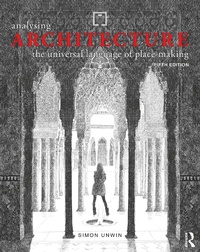
Analysing Architecture
The universal language of place-making
5th Edition
Published on 30. December 2020
Book
Hardback
326 pages
978-0-367-52357-2 (ISBN)
Description
Now in its fifth edition, Analysing Architecture has become internationally established as the best introduction to architecture. Aimed primarily at those studying architecture, it offers a clear and accessible insight into the workings of this rich and fascinating subject. With copious illustrations from his own notebooks, the author dissects examples from around the world and all periods of history to explain the underlying strategies in architectural design and show how drawing may be used as a medium for analysis.
In this new edition, Analysing Architecture has been revised and expanded. Notably, the chapter on 'How Analysis Can Help Design' has been redeveloped to clearly explain this crucially important aspect of study to a beginner readership. Four new chapters have been added to the section dealing with Themes in Spatial Organisation, on 'Axis', 'Grid', 'Datum Place' and 'Hidden'. Material from the 'Case Studies' in previous editions has been redistributed amongst earlier chapters. The 'Introduction' has been completely rewritten; and the format of the whole book has been adjusted to allow for the inclusion of more and better illustrative examples.
Works of architecture are instruments for managing, orchestrating, modifying our relationship with the world around us. They frame just about everything we do. Architecture is complex, subtle, frustrating... but ultimately extremely rewarding. It can be a difficult discipline to get to grips with; nothing in school quite prepares anyone for the particular demands of an architecture course. But this book will help.
www.instagram.com/analysingarchitecture
In this new edition, Analysing Architecture has been revised and expanded. Notably, the chapter on 'How Analysis Can Help Design' has been redeveloped to clearly explain this crucially important aspect of study to a beginner readership. Four new chapters have been added to the section dealing with Themes in Spatial Organisation, on 'Axis', 'Grid', 'Datum Place' and 'Hidden'. Material from the 'Case Studies' in previous editions has been redistributed amongst earlier chapters. The 'Introduction' has been completely rewritten; and the format of the whole book has been adjusted to allow for the inclusion of more and better illustrative examples.
Works of architecture are instruments for managing, orchestrating, modifying our relationship with the world around us. They frame just about everything we do. Architecture is complex, subtle, frustrating... but ultimately extremely rewarding. It can be a difficult discipline to get to grips with; nothing in school quite prepares anyone for the particular demands of an architecture course. But this book will help.
www.instagram.com/analysingarchitecture
Reviews / Votes
"Probably the best introductory book on architecture."Andrew Higgott, Lecturer in Architecture, University of East London, UK
"A truly amazing book on how to analyze a building. A must read for all young architects."
Fatema, Goodreads.com
More details
Edition
5th edition
Language
English
Place of publication
London
United Kingdom
Publishing group
Taylor & Francis Ltd
Target group
College/higher education
Illustrations
951 s/w Abbildungen, 951 s/w Zeichnungen
951 Line drawings, black and white; 951 Illustrations, black and white
Dimensions
Height: 276 mm
Width: 219 mm
Weight
1380 gr
ISBN-13
978-0-367-52357-2 (9780367523572)
Copyright in bibliographic data and cover images is held by Nielsen Book Services Limited or by the publishers or by their respective licensors: all rights reserved.
Schweitzer Classification
Other editions
Additional editions
Book
12/2020
5th Edition
Routledge
€56.00
Shipment within 15-20 days
E-Book
12/2020
5th Edition
Routledge
€59.49
Available for download
E-Book
12/2020
5th Edition
Routledge
€59.49
Available for download
Previous edition
Person
Simon Unwin is Emeritus Professor of Architecture at the University of Dundee, Scotland. He has lived in Great Britain and Australia, and taught or lectured on his work in China, Israel, India, Sweden, Turkey and the United States. Analysing Architecture's international relevance is indicated by its translation into various languages and its adoption for architecture courses around the world. Now retired, Simon Unwin continues to teach at The Welsh School of Architecture in Cardiff, UK.
Content
Preface to this New Edition. Introduction. Architecture as Intellectual Structure and Identification of Place. Basic Elements of Architecture. Modifying Elements of Architecture. Elements Doing More Than One Thing. Using Things That Are There. Primitive Place Types. Architecture as Making Frames. Geometries of Being. Ideal Geometry. Themes in Spatial Organisation: 1. Space and Structure. 2. Parallel Walls. 3. Axis. 4. Grid. 5. Datum Place. 6. Stratification. 7. Transition, Hierarchy, Heart. 8. In-between. 9. Inhabited Wall. 10. Hidden. 11. Refuge and Prospect. Temples and Cottages. How Analysis Can Help Design. Postscript. Acknowledgements. Bibliography and References. Index.