

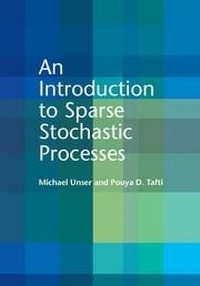
An Introduction to Sparse Stochastic Processes
Will be published approx. on 21. August 2014
Book
Hardback
384 pages
978-1-107-05854-5 (ISBN)
Description
Providing a novel approach to sparsity, this comprehensive book presents the theory of stochastic processes that are ruled by linear stochastic differential equations, and that admit a parsimonious representation in a matched wavelet-like basis. Two key themes are the statistical property of infinite divisibility, which leads to two distinct types of behaviour - Gaussian and sparse - and the structural link between linear stochastic processes and spline functions, which is exploited to simplify the mathematical analysis. The core of the book is devoted to investigating sparse processes, including a complete description of their transform-domain statistics. The final part develops practical signal-processing algorithms that are based on these models, with special emphasis on biomedical image reconstruction. This is an ideal reference for graduate students and researchers with an interest in signal/image processing, compressed sensing, approximation theory, machine learning, or statistics.
Reviews / Votes
'Over the last twenty years, sparse representation of images and signals became a very important topic in many applications, ranging from data compression, to biological vision, to medical imaging. The book An Introduction to Sparse Stochastic Processes by Unser and Tafti is the first work to systematically build a coherent framework for non-Gaussian processes with sparse representations by wavelets. Traditional concepts such as Karhunen-Loeve analysis of Gaussian processes are nicely complemented by the wavelet analysis of Levy Processes which is constructed here. The framework presented here has a classical feel while accommodating the innovative impulses driving research in sparsity. The book is extremely systematic and at the same time clear and accessible, and can be recommended both to engineers interested in foundations and to mathematicians interested in applications.' David Donoho, Stanford University 'This is a fascinating book that connects the classical theory of generalised functions (distributions) to the modern sparsity-based view on signal processing, as well as stochastic processes. Some of the early motivations given by I. Gelfand on the importance of generalised functions came from physics and, indeed, signal processing and sampling. However, this is probably the first book that successfully links the more abstract theory with modern signal processing. A great strength of the monograph is that it considers both the continuous and the discrete model. It will be of interest to mathematicians and engineers having appreciations of mathematical and stochastic views of signal processing.' Anders Hansen, University of CambridgeMore details
Language
English
Place of publication
Cambridge
United Kingdom
Target group
Professional and scholarly
Product notice
Laminated cover
Illustrations
12 Tables, black and white; 47 Line drawings, unspecified
Dimensions
Height: 254 mm
Width: 179 mm
Thickness: 25 mm
Weight
922 gr
ISBN-13
978-1-107-05854-5 (9781107058545)
Copyright in bibliographic data and cover images is held by Nielsen Book Services Limited or by the publishers or by their respective licensors: all rights reserved.
Schweitzer Classification
Other editions
Additional editions
Michael Unser
Introduction to Sparse Stochastic Processes
E-Book
08/2014
Cambridge University Press
€34.49
Available for download
Michael Unser | Pouya D. Tafti
An Introduction to Sparse Stochastic Processes
E-Book
08/2014
1st Edition
Cambridge University Press
€39.99
Available for download
Persons
Michael Unser is Professor and Director of EPFL's Biomedical Imaging Group, Switzerland. He is a member of the Swiss Academy of Engineering Sciences, a Fellow of EURASIP, and a Fellow of the IEEE. Pouya D. Tafti is a data scientist currently residing in Germany, and a former member of the Biomedical Imaging Group at EPFL, where he conducted research on the theory and applications of probabilistic models for data.
Content
1. Introduction; 2. Roadmap to the book; 3. Mathematical context and background; 4. Continuous-domain innovation models; 5. Operators and their inverses; 6. Splines and wavelets; 7. Sparse stochastic processes; 8. Sparse representations; 9. Infinite divisibility and transform-domain statistics; 10. Recovery of sparse signals; 11. Wavelet-domain methods; 12. Conclusion; Appendix A. Singular integrals; Appendix B. Positive definiteness; Appendix C. Special functions.