

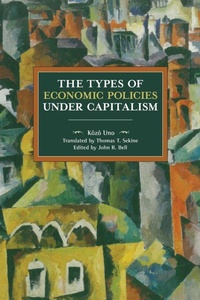
The Types Of Economic Policy Under Capitalism
Published on 20. February 2018
Book
Paperback/Softback
352 pages
978-1-60846-802-7 (ISBN)
Description
Kozo Uno is widely recognised as one of the most important Marxist economists of the 20th century, and yet most of his work remains untranslated and thus unavailable to the Anglo-Saxon world. This English language edition of his influential Keizai-Seisakuron introduces Uno's argument for a mid-range theory of capitalism's developmental stages - one that exists between pure theory and full empiricism.
More details
Language
English
Place of publication
Chicago
United States
Product notice
Paperback (trade)
Unsewn / adhesive bound
Dimensions
Height: 228 mm
Width: 151 mm
Thickness: 22 mm
Weight
484 gr
ISBN-13
978-1-60846-802-7 (9781608468027)
Copyright in bibliographic data and cover images is held by Nielsen Book Services Limited or by the publishers or by their respective licensors: all rights reserved.
Schweitzer Classification
Person
Kozo Uno (1897?1977) was a Japanese Marxian economist who made many path-breaking contributions to Marx's theory of value.
Content
Foreword to the Revised Edition of 1971
Introduction
The commodity-economy and economic policies
The task and method of the study of economic policies
The study of economic policies and economics
PART I: MERCANTILISM
1. The Formative Period of Capitalism
2. The English Wool Industry Representing Merchant Capital
3. The Economic Policies of Mercantilism
PART II: LIBERALISM
4. The Period of the Self-Propelled Growth of Capitalism
5. The British Cotton Industry Representing Industrial Capital
The development of the cotton industry
The British cotton industry and international trade
6. The Economic Policies of Liberalism
The free trade movement in Britain
The internationalisation of the free trade movement as a sequel to its success in Britain
Tariff protectionism in the United States
Free trade and tariff protection
PART III: IMPERIALISM
7. Capitalism in its Decline
The concentration of capital and the bulking large of fixed capital
The functioning of the joint-stock company
The capital of a joint-stock company
Joint-stock companies and banks
The joint-stock company as means of concentrating managerial control
The mode of accumulation of finance-capital
8. Multiple Faces of Finance-Capital
The development of monopoly organisations in and around the heavy industries in Germany
Britain's overseas investment
The trust movement in the United States
9. Economic Policies of Imperialism
Customs policy and dumping
The acquisition of colonies and the export of capital
Conclusion
Memorandum on Capitalist Development after the First World War (1970)
Translator's Afterword
Appendices: Two Essays by Thomas T. Sekine
Appendix 1: An Essay on Uno's Stages-Theory of Capitalist Development: What Might We Learn from this Book?
Appendix 2: An Essay on Transition away from Capitalism: How Might Unoists Account for the Evolution of the post-1914 World Economy?
References
Index of Names
Index of Subjects
Introduction
The commodity-economy and economic policies
The task and method of the study of economic policies
The study of economic policies and economics
PART I: MERCANTILISM
1. The Formative Period of Capitalism
2. The English Wool Industry Representing Merchant Capital
3. The Economic Policies of Mercantilism
PART II: LIBERALISM
4. The Period of the Self-Propelled Growth of Capitalism
5. The British Cotton Industry Representing Industrial Capital
The development of the cotton industry
The British cotton industry and international trade
6. The Economic Policies of Liberalism
The free trade movement in Britain
The internationalisation of the free trade movement as a sequel to its success in Britain
Tariff protectionism in the United States
Free trade and tariff protection
PART III: IMPERIALISM
7. Capitalism in its Decline
The concentration of capital and the bulking large of fixed capital
The functioning of the joint-stock company
The capital of a joint-stock company
Joint-stock companies and banks
The joint-stock company as means of concentrating managerial control
The mode of accumulation of finance-capital
8. Multiple Faces of Finance-Capital
The development of monopoly organisations in and around the heavy industries in Germany
Britain's overseas investment
The trust movement in the United States
9. Economic Policies of Imperialism
Customs policy and dumping
The acquisition of colonies and the export of capital
Conclusion
Memorandum on Capitalist Development after the First World War (1970)
Translator's Afterword
Appendices: Two Essays by Thomas T. Sekine
Appendix 1: An Essay on Uno's Stages-Theory of Capitalist Development: What Might We Learn from this Book?
Appendix 2: An Essay on Transition away from Capitalism: How Might Unoists Account for the Evolution of the post-1914 World Economy?
References
Index of Names
Index of Subjects