

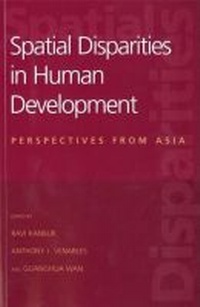
Spatial disparities in human development
perspectives from Asia
Published on 30. April 2006
Book
Paperback/Softback
344 pages
978-92-808-1122-3 (ISBN)
Description
Spatial disparities are a measure of the unequal distribution of income and wealth, power and resources between peoples in different locations, and this topic has added significance when spatial and regional divisions align with political and ethnic tensions to undermine social and political stability. This publication contains a selection of papers presented at a UNU conference, held in March 2003 in Tokyo, Japan, which consider spatial inequality in Asia from a variety of perspectives by prominent economists in the area of inequality and development studies, particularly in relation to the Millennium Development Goals.
Reviews / Votes
"The papers in this volume represent economists' great efforts to achieve a better understanding and measurement of rising regional disparities facing Asian economies. Its theoretical and methodological contents make this book of much value to both students of economics and to policymakers in developing Asia." ?Zhang Jun, China Centre for Economic Studies, Fudan University, Shanghai, China|"Kanbur, Venables and Wan make an important contribution by bringing together a collection of articles that discuss not only methodological issues in measuring regional disparities but also empirical evidence from small and large countries of Asia. Of interest are the varied explanations of what causes these inequalities that will no doubt be useful for policymakers and practitioners dealing with development issues." ?Brinda Viswanathan, Institute for Social and Economic Change, Bangalore, India
|"The great value of this book comes from comparing, through detailed analysis, the problems of regional inequality and poverty in different Asian countries. Spatial inequality is of interest in its own right, but the topic of the book takes on an added significance when spatial and regional divisions align with political and ethnic tensions to undermine social and political stability. With contributions from leading regional scientists and economists, this book also examines the policy experience of Asian countries in closing regional gaps and the effectiveness of public interventions in this field." ?Jussi Pakkasvirta, Institute of Development Studies, University of Helsinki, Finland
More details
Language
English
Place of publication
Tokyo
Japan
Target group
Professional and scholarly
Illustrations
figs., tables
Dimensions
Height: 229 mm
Width: 152 mm
ISBN-13
978-92-808-1122-3 (9789280811223)
Copyright in bibliographic data and cover images is held by Nielsen Book Services Limited or by the publishers or by their respective licensors: all rights reserved.
Schweitzer Classification
Persons
Ravi Kanbur is the T. H. Lee Professor of World Affairs and professor of economics at Cornell University. Anthony J.Venables is chief economist in the UK Department for International Development and professor of international economics at the London School of Economics. Anthony J. Venables is chief economist in the UK Department for International Development and professor of international economics at the London School of Economics. Guanghua Wan is a senior research fellow and project director at UNU-WIDER, Finland.