

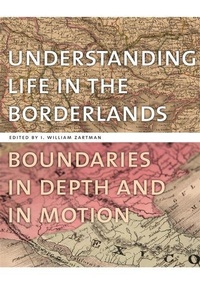
Understanding Life in the Borderlands
Boundaries in Depth and in Motion
University of Georgia Press
Published on 1. February 2010
Book
Hardback
256 pages
978-0-8203-3385-4 (ISBN)
Description
The past two decades have seen an intense, interdisciplinary interest in the border areas between states-inhabited territories located on the margins of a power center or between power centers. This timely and highly original collection of essays edited by noted scholar I. William Zartman is an attempt "to begin to understand both these areas and the interactions that occur within and across them"-that is, to understand how borders affect the groups living along them and the nature of the land and people abutting on and divided by boundaries.
These essays highlight three defining features of border areas: borderlanders constitute an experiential and culturally identifiable unit; borderlands are characterized by constant movement (in time, space, and activity); and in their mobility, borderlands always prepare for the next move at the same time that they respond to the last one. The ten case studies presented range over four millennia and provide windows for observing the dynamics of life in borderlands. They also have policy relevance, especially in creating an awareness of borderlands as dynamic social spheres and of the need to anticipate the changes that given policies will engender-changes that will in turn require their own solutions. Contrary to what one would expect in this age of globalization, says Zartman, borderlands maintain their own dynamics and identities and indeed spread beyond the fringes of the border and reach deep into the hinterland itself.
These essays highlight three defining features of border areas: borderlanders constitute an experiential and culturally identifiable unit; borderlands are characterized by constant movement (in time, space, and activity); and in their mobility, borderlands always prepare for the next move at the same time that they respond to the last one. The ten case studies presented range over four millennia and provide windows for observing the dynamics of life in borderlands. They also have policy relevance, especially in creating an awareness of borderlands as dynamic social spheres and of the need to anticipate the changes that given policies will engender-changes that will in turn require their own solutions. Contrary to what one would expect in this age of globalization, says Zartman, borderlands maintain their own dynamics and identities and indeed spread beyond the fringes of the border and reach deep into the hinterland itself.
Reviews / Votes
This is a highly original scholarly collection on an important topic-the borderlands between the states. The editor has done a superb job of bringing together scholars from a variety of disciplines. Zartman's juxtaposition of three spatial models of boundaries is very useful for exploding some of the predominant nationalist and state-centric myths surrounding boundaries, especially within policy circles. In addition, the book adds new insights into the various processes that lead to conflict between borderlands and the center. Overall, this is an impressive volume both for its original scholarship and its perceptions regarding our theoretical understanding about boundaries and borderlands. -- John Vasquez * Thomas B. Mackie Scholar in International Relations, University of Illinois at Urbana-Champaign * Understanding Life in the Borderlands offers everything an edited volume should have and almost never does-thesis, conversation among authors, sparkling case studies, and brilliant theoretical analysis. In the hands of the book's contributors, Zartman's model of borderlands as dynamic social processes, where the intractable complexities of life and the ingenuities of people meet the rigidities of sharp political boundaries, offers an exciting, multidisciplinary advance in our understanding of the relationships between places and spaces. -- Ian S. Lustick * author of <i>Unsettled States, Disputed Lands</i> * An imaginative tour de force, tour du monde, and tour du temps that brings together multiple strands of scholarship covering four millennia and four continents to help us understand the nature and impact of our globalized condition. Today, all lands are borderlands. -- Dr. Mary Ellen Lane * Executive Director, Council of American Overseas Research Center *More details
Series
Language
English
Place of publication
Georgia
United States
Target group
Adult education
Professional and scholarly
Product notice
Cloth over boards
Illustrations
4 b&w photos and 3 figures
Dimensions
Height: 229 mm
Width: 152 mm
Thickness: 21 mm
Weight
589 gr
ISBN-13
978-0-8203-3385-4 (9780820333854)
Copyright in bibliographic data and cover images is held by Nielsen Book Services Limited or by the publishers or by their respective licensors: all rights reserved.
Schweitzer Classification
Other editions
Additional editions
E-Book
01/2010
University of Georgia Press
€30.49
Available for download
Persons
I. WILLIAM ZARTMAN is Jacob Blaustein Professor Emeritus of International Organizations and Conflict Resolution at the Paul H. Nitze School of Advanced International Studies, Johns Hopkins University, and former president of the Middle East Studies Associations and of the American Institute for Maghrib Studies. Zartman has written, edited, or coedited some twenty books, including Understanding Life in the Borderlands: Boundaries in Depth and in Motion (Georgia).