

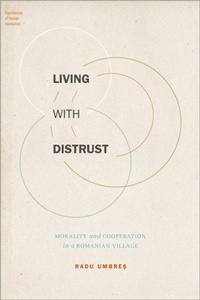
Living with Distrust
Morality and Cooperation in a Romanian Village
Published on 14. November 2022
Book
Hardback
248 pages
978-0-19-086990-8 (ISBN)
Description
People in the Romanian village of Sateni distrust each other so much, that they would rather take a building apart than share it. Satenis think of life as struggle for scarce resources--a struggle that can lead to deception, exploitation, or predation. Cooperation with unrelated or unfamiliar partners fails while distrust permeates everyday life and cultural representations. Yet, each person engages in profound relationships with a particular set of people, expressed in cooperative actions. Living in Distrust makes sense of this worldview-one divided between strong moral relationships and deep suspicion towards the rest of the village society-through an ethnography of distrust.
Drawing on two years of fieldwork, Radu Umbres offers an interdisciplinary interpretation of social interactions in a low trust society. This cognitive ethnography argues that the costs of misplaced trust made Sateni restrict their cooperative behavior to a safe set of social relationships: family, kinship, and friendship ties. Umbres explains how mutual trust appears by social agreement around culturally-codified institutions and persists only by fair cooperative interactions. Despite scarce representations or investments in the common good, the village society reproduces its low-level equilibrium of cooperation in relative stability. In an exploration of the structural influences on community morality and a defense of distrust, the book also demonstrates how investing trust in family first is an optimal strategy against ecological or political risks.
By highlighting a system of dual morality sharply distinct from the Western-liberal ethos, Living with Distrust addresses perennial moral dilemmas and essential questions of secrecy and honesty, distrust and reputation.
Drawing on two years of fieldwork, Radu Umbres offers an interdisciplinary interpretation of social interactions in a low trust society. This cognitive ethnography argues that the costs of misplaced trust made Sateni restrict their cooperative behavior to a safe set of social relationships: family, kinship, and friendship ties. Umbres explains how mutual trust appears by social agreement around culturally-codified institutions and persists only by fair cooperative interactions. Despite scarce representations or investments in the common good, the village society reproduces its low-level equilibrium of cooperation in relative stability. In an exploration of the structural influences on community morality and a defense of distrust, the book also demonstrates how investing trust in family first is an optimal strategy against ecological or political risks.
By highlighting a system of dual morality sharply distinct from the Western-liberal ethos, Living with Distrust addresses perennial moral dilemmas and essential questions of secrecy and honesty, distrust and reputation.
More details
Series
Language
English
Place of publication
New York
United States
Target group
College/higher education
Product notice
sewn/stitched
Cloth over boards
Illustrations
9 b/w illustrations
Dimensions
Height: 237 mm
Width: 163 mm
Thickness: 21 mm
Weight
517 gr
ISBN-13
978-0-19-086990-8 (9780190869908)
Copyright in bibliographic data and cover images is held by Nielsen Book Services Limited or by the publishers or by their respective licensors: all rights reserved.
Schweitzer Classification
Other editions
Additional editions
E-Book
08/2022
OUP eBook
€56.99
Available for download
E-Book
08/2022
OUP eBook
€56.99
Available for download
Person
Radu Umbres is an anthropologist fusing ethnographic research with cognitive approaches to morality, cooperation, and communication. He studied Sociology at the University of Bucharest and the University of Oxford, followed by a PhD in Anthropology at University College London after two years of fieldwork in a Romanian village. After postdoctoral fellowships at Institut Jean Nicod, Paris and New Europe College, he currently teaches at National School of Political and Administrative Studies Bucharest. His recent work focuses on apparently-irrational cultural imitation in cargo cults, the mechanisms of social initiation by pranking, and revisiting other classical themes in anthropology from a cognitive perspective.
Content
Prologue: Ripping the collective apart Introduction to Sateni Chapter 1: The Deep Play of Tavern Distrust 1.1 Reputation and vigilance in dramaturgical tournaments 1.2 Cues and inferences in selective social intercourse 1.3 Exploitation and generosity 1.5 Domination as proven reputation 1.6 Luck and agency 1.7 The importance of vigilant minds 1.8 Society as competition Chapter 2: The Houses of Trust, the Fences of Distrust 2.1 The ecology and ideology of a domestic mode of production 2.2 Autarchy as safe atomisation 2.3 Domestic survival against authoritarian collectivism 2.4 Conspiratorial flexibility and opportunistic collaborationism 2.5 Keeping evil away from home 2.6 Whitewashed reputations and imaginative suspicions 2.7 The household as family coordination and interdependence 2.8 A society of households Chapter 3: Making and Unmaking Kinship Part I. "Brother-brother, but cheese costs money" 3.1 Sibling equity and fair marriages
3.2 The many problems of dividing property between relatives 3.3 Rituals of kin separation and creation
3.4 Moral readjustments in the domestic cycle of reproduction
3.5 Partner choice in "holding" and "not holding on to kin" Part II: Adapting relatedness to fairness 3.6 Changing families, changing weddings
3.7 Calling out and keeping kinship accounts 3.8 Choosing relatives by moral obligations 3.9 A fair replacement for blood 3.10 The importance of being kin Chapter 4: Death and the Regeneration of Trust 4.1 Being there: the morality of reckoning death 4.2 Death and final reputations 4.3 Funeral symbols of mutuality 4.4 The society of the dead 4.5 The drama of private graves...
4.6 ...and the tragedy of the common graveyard 4.7 The life and death of trust Chapter 5: The Political Stability of Social Fragmentation 5.1 The making of a political entrepreneur 5.2 Ritual politics and political transactions 5.3 Smart thieves and political idiots
5.4 Local governance as patrimony 5.5 Plus ca change...
5.6 ...plus c'est la meme chose
5.7 The moral reproduction of political markets Chapter 6: Changes in the construction of trust 6.1 The hurdles of economic distrust 6.2 The road to entrepreneurship 6.3 Pricing old trust for new houses 6.4 Fairness between the short-term and the long-term 6.5 Creating trust under social and technological uncertainty 6.6 Cheaters and superpartners 6.7 The ethical fashioning of entrepreneurial self 6.8 Moral inclinations and moral environments Chapter 7: To trust or not to trust 7.1 Living in a culture of distrust 7.2 The weight of history 7.3 The flexibility of personalized trust 7.4 The future of cooperation and morality 7.3 The reasons of distrust Notes References
3.2 The many problems of dividing property between relatives 3.3 Rituals of kin separation and creation
3.4 Moral readjustments in the domestic cycle of reproduction
3.5 Partner choice in "holding" and "not holding on to kin" Part II: Adapting relatedness to fairness 3.6 Changing families, changing weddings
3.7 Calling out and keeping kinship accounts 3.8 Choosing relatives by moral obligations 3.9 A fair replacement for blood 3.10 The importance of being kin Chapter 4: Death and the Regeneration of Trust 4.1 Being there: the morality of reckoning death 4.2 Death and final reputations 4.3 Funeral symbols of mutuality 4.4 The society of the dead 4.5 The drama of private graves...
4.6 ...and the tragedy of the common graveyard 4.7 The life and death of trust Chapter 5: The Political Stability of Social Fragmentation 5.1 The making of a political entrepreneur 5.2 Ritual politics and political transactions 5.3 Smart thieves and political idiots
5.4 Local governance as patrimony 5.5 Plus ca change...
5.6 ...plus c'est la meme chose
5.7 The moral reproduction of political markets Chapter 6: Changes in the construction of trust 6.1 The hurdles of economic distrust 6.2 The road to entrepreneurship 6.3 Pricing old trust for new houses 6.4 Fairness between the short-term and the long-term 6.5 Creating trust under social and technological uncertainty 6.6 Cheaters and superpartners 6.7 The ethical fashioning of entrepreneurial self 6.8 Moral inclinations and moral environments Chapter 7: To trust or not to trust 7.1 Living in a culture of distrust 7.2 The weight of history 7.3 The flexibility of personalized trust 7.4 The future of cooperation and morality 7.3 The reasons of distrust Notes References