

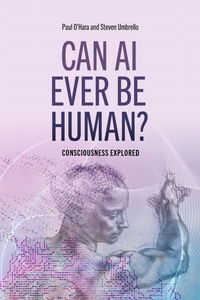
Can AI Ever Be Human?
Consciousness Explored
Published on 8. May 2026
Book
Paperback/Softback
232 pages
978-0-8132-4086-2 (ISBN)
Description
Can a machine ever truly be human? In an age where artificial intelligence writes poems, diagnoses illnesses, and converses with uncanny fluency, the line between human and machine seems to blur. Yet beneath the surface lies a fundamental distinction. Drawing on Bernard Lonergan's insights as well as the rich Catholic intellectual tradition, Can AI Ever Be Human? argues that while machines can simulate aspects of human behavior, they cannot cross the threshold into genuine consciousness.
O'Hara and Umbrello guide readers through the essential structures of human knowing: experience, understanding, judgment, and decision. In doing so, they show how each involves intentionality, self-awareness, and freedom. These uniquely human capacities cannot be reduced to algorithms or replicated by even the most advanced neural networks.
The book also addresses pressing ethical and theological questions: What does it mean to be made in the image of God? How do we preserve human dignity in a world increasingly shaped by artificial intelligence? Far from being anti-technology, O'Hara and Umbrello affirm the value of AI as a tool that emulates a Turing machine, although constrained by Goedel's theorem, while rejecting the illusion that it can replace human beings.
Accessible yet rigorous, Can AI Ever Be Human? speaks to scholars, students, clergy, and general readers alike. It is essential reading for anyone interested in the intersection of technology, scientific methodology, philosophy, and theology, and for all who seek to understand what makes us irreducibly human in an era of rapid technological change.
O'Hara and Umbrello guide readers through the essential structures of human knowing: experience, understanding, judgment, and decision. In doing so, they show how each involves intentionality, self-awareness, and freedom. These uniquely human capacities cannot be reduced to algorithms or replicated by even the most advanced neural networks.
The book also addresses pressing ethical and theological questions: What does it mean to be made in the image of God? How do we preserve human dignity in a world increasingly shaped by artificial intelligence? Far from being anti-technology, O'Hara and Umbrello affirm the value of AI as a tool that emulates a Turing machine, although constrained by Goedel's theorem, while rejecting the illusion that it can replace human beings.
Accessible yet rigorous, Can AI Ever Be Human? speaks to scholars, students, clergy, and general readers alike. It is essential reading for anyone interested in the intersection of technology, scientific methodology, philosophy, and theology, and for all who seek to understand what makes us irreducibly human in an era of rapid technological change.
More details
Language
English
Place of publication
Washington
United States
Target group
College/higher education
Professional and scholarly
Product notice
Paperback (trade)
Dimensions
Height: 216 mm
Width: 144 mm
Thickness: 18 mm
Weight
354 gr
ISBN-13
978-0-8132-4086-2 (9780813240862)
Copyright in bibliographic data and cover images is held by Nielsen Book Services Limited or by the publishers or by their respective licensors: all rights reserved.
Schweitzer Classification
Persons
Paul O' Hara is a professor of ontology and scientific rationality at Sophia University, Italy. Steven Umbrello is Managing Director at the Institute for Ethics and Emerging Technologies.