

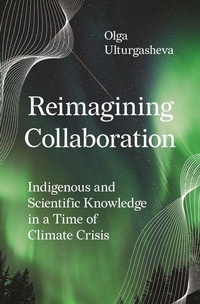
Reimagining Collaboration
Indigenous and Scientific Knowledge in a Time of Climate Crisis
Will be published approx. on 2. February 2027
Book
Paperback/Softback
232 pages
978-0-691-25781-5 (ISBN)
Description
A new direction for collaborative climate science, grounded in Indigenous concepts of togetherness, sharing, and generative convergence
Across universities, labs, NGOs, and public agencies, collaboration has become a compulsory virtue, especially in climate and environmental science. Many such partnerships with Indigenous communities, however, are largely performative, with Indigenous participation merely tokenistic. These collaborations are often rushed by funding cycles, shaped by prestige hierarchies, and organized so that Indigenous expertise is consulted, extracted, or translated into "data," while scientific agendas stay largely unchanged. In Reimagining Collaboration, social anthropologist Olga Ulturgasheva offers a new analytic and practical model for collaborative climate science: coupling, a deliberate, mediated convergence of distinct knowledge traditions that does not erase difference but uses it to generate new capacities for action.
Ulturgasheva emphasizes the importance of the skilled facilitator or "human interface" (often an Indigenous scholar) as a catalyst for the encounter between scientific and Indigenous knowledge. Drawing on fifteen years of fieldwork and close engagement with cross-disciplinary projects, Ulturgasheva-herself a member of the Eveny Indigenous community of Siberia-shows that these collaborations succeed or fail at the level of method: how problems are framed, who gets to define evidence, what counts as proof, and how authority is silently reproduced. She proposes a set of principles, grounded in Eveny concepts of togetherness, sharing, and generative convergence, for designing collaborations that are ethical, scientifically robust, and aligned with the values of decolonization.
Olga Ulturgasheva is associate professor in social anthropology in the School of Social Sciences at the University of Manchester. She is the author of Narrating the Future in Siberia and the coeditor of Risky Futures.
Across universities, labs, NGOs, and public agencies, collaboration has become a compulsory virtue, especially in climate and environmental science. Many such partnerships with Indigenous communities, however, are largely performative, with Indigenous participation merely tokenistic. These collaborations are often rushed by funding cycles, shaped by prestige hierarchies, and organized so that Indigenous expertise is consulted, extracted, or translated into "data," while scientific agendas stay largely unchanged. In Reimagining Collaboration, social anthropologist Olga Ulturgasheva offers a new analytic and practical model for collaborative climate science: coupling, a deliberate, mediated convergence of distinct knowledge traditions that does not erase difference but uses it to generate new capacities for action.
Ulturgasheva emphasizes the importance of the skilled facilitator or "human interface" (often an Indigenous scholar) as a catalyst for the encounter between scientific and Indigenous knowledge. Drawing on fifteen years of fieldwork and close engagement with cross-disciplinary projects, Ulturgasheva-herself a member of the Eveny Indigenous community of Siberia-shows that these collaborations succeed or fail at the level of method: how problems are framed, who gets to define evidence, what counts as proof, and how authority is silently reproduced. She proposes a set of principles, grounded in Eveny concepts of togetherness, sharing, and generative convergence, for designing collaborations that are ethical, scientifically robust, and aligned with the values of decolonization.
Olga Ulturgasheva is associate professor in social anthropology in the School of Social Sciences at the University of Manchester. She is the author of Narrating the Future in Siberia and the coeditor of Risky Futures.
More details
Language
English
Place of publication
New Jersey
United States
Target group
College/higher education
Professional and scholarly
Product notice
Paperback (trade)
Illustrations
9 b/w illus. 1 map.
Dimensions
Height: 235 mm
Width: 156 mm
ISBN-13
978-0-691-25781-5 (9780691257815)
Copyright in bibliographic data and cover images is held by Nielsen Book Services Limited or by the publishers or by their respective licensors: all rights reserved.
Schweitzer Classification
Person
Olga Ulturgasheva is associate professor in social anthropology in the School of Social Sciences at the University of Manchester. She is the author of Narrating the Future in Siberia and the coeditor of Risky Futures.