

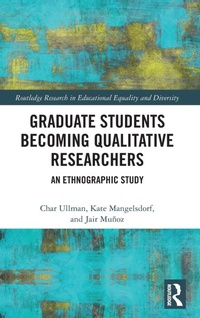
Graduate Students Becoming Qualitative Researchers
An Ethnographic Study
1st Edition
Published on 24. November 2020
Book
Hardback
286 pages
978-1-138-08730-9 (ISBN)
Description
Through conducting an ethnographic study about doctoral students from traditionally underrepresented groups who are learning to conduct ethnographic research, this volume offers unique insight into the challenges and experiences through which these students develop their skills and identities as qualitative researchers.
Foregrounding the stories and perspectives of students from minority backgrounds including Latinx, Black, differently abled, and queer students, Graduate Students Becoming Qualitative Researchers identifies how the process of learning to conduct ethnographic research underpins doctoral students' success, confidence, and persistence in the academy. Chapters follow students during a one-year ethnographic research course during which they learn about ethnography, and also conduct observations, write field notes, interview participants, and gather artifacts. Offering important pedagogical insights into how ethnography and academic writing are communicated, the text also tackles questions of access and diversity within scholarship and highlights barriers to first-generation and minoritized students' success, including impostor syndrome, stereotype vulnerability, and access to time, knowledge, and capital.
This volume will prove valuable to doctoral students, postgraduate researchers, scholars, and educators conducting qualitative research across the fields of education and rhetoric, as well as the humanities and social sciences. It will also appeal to those interested in multiculturalism and diversity within the education sector.
Foregrounding the stories and perspectives of students from minority backgrounds including Latinx, Black, differently abled, and queer students, Graduate Students Becoming Qualitative Researchers identifies how the process of learning to conduct ethnographic research underpins doctoral students' success, confidence, and persistence in the academy. Chapters follow students during a one-year ethnographic research course during which they learn about ethnography, and also conduct observations, write field notes, interview participants, and gather artifacts. Offering important pedagogical insights into how ethnography and academic writing are communicated, the text also tackles questions of access and diversity within scholarship and highlights barriers to first-generation and minoritized students' success, including impostor syndrome, stereotype vulnerability, and access to time, knowledge, and capital.
This volume will prove valuable to doctoral students, postgraduate researchers, scholars, and educators conducting qualitative research across the fields of education and rhetoric, as well as the humanities and social sciences. It will also appeal to those interested in multiculturalism and diversity within the education sector.
More details
Series
Language
English
Place of publication
London
United Kingdom
Publishing group
Taylor & Francis Ltd
Target group
College/higher education
Illustrations
26 s/w Tabellen
26 Tables, black and white
Dimensions
Height: 235 mm
Width: 157 mm
Thickness: 20 mm
Weight
571 gr
ISBN-13
978-1-138-08730-9 (9781138087309)
Copyright in bibliographic data and cover images is held by Nielsen Book Services Limited or by the publishers or by their respective licensors: all rights reserved.
Schweitzer Classification
Other editions
Additional editions
Char Ullman | Kate Mangelsdorf | Jair Munoz
Graduate Students Becoming Qualitative Researchers
An Ethnographic Study
Book
05/2022
1st Edition
Routledge
€63.60
Shipment within 15-20 days
Char Ullman | Kate Mangelsdorf | Jair Munoz
Graduate Students Becoming Qualitative Researchers
An Ethnographic Study
E-Book
11/2020
1st Edition
Routledge
€55.49
Available for download
Char Ullman | Kate Mangelsdorf | Jair Munoz
Graduate Students Becoming Qualitative Researchers
An Ethnographic Study
E-Book
11/2020
1st Edition
Routledge
€55.49
Available for download
Persons
Char Ullman is Associate Professor of Sociocultural Foundations of Education and Educational Anthropology at the University of Texas at El Paso, USA.
Kate Mangelsdorf is Professor of Rhetoric and Composition Studies at the University of Texas at El Paso, USA.
Jair Munoz is Doctoral Student in the Teaching, Learning, and Culture program at the University of Texas at El Paso, USA.
Kate Mangelsdorf is Professor of Rhetoric and Composition Studies at the University of Texas at El Paso, USA.
Jair Munoz is Doctoral Student in the Teaching, Learning, and Culture program at the University of Texas at El Paso, USA.
Content
1. Who Gets to Become a Professor?: Paving the Way for Diversity in the Academy.
2. Situating the Study: Conducting Ethnographic Research with Doctoral Students on the U.S.-Mexico Border
3. Belonging and Becoming: Understanding and Overcoming Barriers to Participation in the Academy
4. Learning to Do Research: Acknowledging Researcher Positionality in Ethnographic Research
5. Building Identity as a Scholar and Researcher: Identity Work, Imposter Syndrome, and Belonging
6. Recognizing the Role of Self-Belief, Motivation, and Personal Sacrifice in Doctoral Students' Success
7. Being and Researching in a Third Space: Embracing Cultural, Linguistic, and Professional Hybridity
8. We Were Never Supposed to Be Here: Overcoming Resistance and Joining Communities of Practice
9. Learning and Not Learning to Become Qualitative Researchers
2. Situating the Study: Conducting Ethnographic Research with Doctoral Students on the U.S.-Mexico Border
3. Belonging and Becoming: Understanding and Overcoming Barriers to Participation in the Academy
4. Learning to Do Research: Acknowledging Researcher Positionality in Ethnographic Research
5. Building Identity as a Scholar and Researcher: Identity Work, Imposter Syndrome, and Belonging
6. Recognizing the Role of Self-Belief, Motivation, and Personal Sacrifice in Doctoral Students' Success
7. Being and Researching in a Third Space: Embracing Cultural, Linguistic, and Professional Hybridity
8. We Were Never Supposed to Be Here: Overcoming Resistance and Joining Communities of Practice
9. Learning and Not Learning to Become Qualitative Researchers