

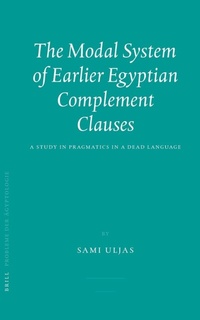
The Modal System of Earlier Egyptian Complement Clauses
A Study in Pragmatics in a Dead Language
Published on 22. June 2007
Book
Hardback
444 pages
978-90-04-15831-3 (ISBN)
Description
The present work proposes a novel analysis of Complement Clauses in Earlier Egyptian language. Contrary to previous assumptions, the grammatical organisation of these constructions is shown to be based on differentiation between Realis and Irrealis modality.
The different types of complement clauses attested in Earlier Egyptian are surveyed utilising recent linguistic research on modality and pragmatics. The discussion is based on numerous examples from the ancient texts and on comparisons with many other languages. Emerging from this investigation is a coherent and principled system for expressing Realis and Irrealis meaning in this most ancient of written languages.
This book is of notable value to Egyptologists working with texts and to all those interested in modality, grammar, and cognition.
The different types of complement clauses attested in Earlier Egyptian are surveyed utilising recent linguistic research on modality and pragmatics. The discussion is based on numerous examples from the ancient texts and on comparisons with many other languages. Emerging from this investigation is a coherent and principled system for expressing Realis and Irrealis meaning in this most ancient of written languages.
This book is of notable value to Egyptologists working with texts and to all those interested in modality, grammar, and cognition.
More details
Series
Language
English
Place of publication
Leiden
Netherlands
Target group
College/higher education
Professional and scholarly
Product notice
sewn/stitched
Cloth over boards
Dimensions
Height: 234 mm
Width: 155 mm
Thickness: 25 mm
Weight
789 gr
ISBN-13
978-90-04-15831-3 (9789004158313)
Copyright in bibliographic data and cover images is held by Nielsen Book Services Limited or by the publishers or by their respective licensors: all rights reserved.
Schweitzer Classification
Other editions
Additional editions

Sami Uljas
The Modal System of Earlier Egyptian Complement Clauses
A Study in Pragmatics in a Dead Language
Software
06/2007
Brill
Unfortunately, price unknown
Available (delivery time upon request)
Person
Sami Uljas, Ph.D. (2005) is a Research fellow of Trinity College, Cambridge University. He is author of many articles on Ancient Egyptian, including Cairo Bowl lines 7-8 (GM 201/2004) and hpr.n and the genesis of auxiliaries (in press).
Content
TABLE OF CONTENTS
Introduction
Structure of the Present Work
PART ONE MODALITY IN AFFIRMATIVE COMPLEMENT CLAUSES AFTER GOVERNING VERBS
1. Introduction to Part One
2. Affirmative Object Complementation after Notionally Assertive Verbs
3. Affirmative Object Complementation after Notionally Non-assertive Verbs
PART TWO MODALITY IN OTHER TYPES OF EARLIER EGYPTIAN COMPLEMENT CLAUSES
4. Modality in Affirmative Subject Complement Clauses
5. Modality in Negative Complement Clauses after Governing Predicates
6. Modality in Complement Clauses after Prepositions
7. Earlier Egyptian Supplementary Patterns of Complementation after Verbs and Prepositions
8. Predicate Complement Clauses
9. At the Crossroads of Tempus and Modus: the Aspectual-Modal Correspondence and the Conceptual Foundations of Irrealis Modality in Earlier Egyptian Complementation
10. Conclusion: Retrospect and Prospect
Introduction
Structure of the Present Work
PART ONE MODALITY IN AFFIRMATIVE COMPLEMENT CLAUSES AFTER GOVERNING VERBS
1. Introduction to Part One
2. Affirmative Object Complementation after Notionally Assertive Verbs
3. Affirmative Object Complementation after Notionally Non-assertive Verbs
PART TWO MODALITY IN OTHER TYPES OF EARLIER EGYPTIAN COMPLEMENT CLAUSES
4. Modality in Affirmative Subject Complement Clauses
5. Modality in Negative Complement Clauses after Governing Predicates
6. Modality in Complement Clauses after Prepositions
7. Earlier Egyptian Supplementary Patterns of Complementation after Verbs and Prepositions
8. Predicate Complement Clauses
9. At the Crossroads of Tempus and Modus: the Aspectual-Modal Correspondence and the Conceptual Foundations of Irrealis Modality in Earlier Egyptian Complementation
10. Conclusion: Retrospect and Prospect