

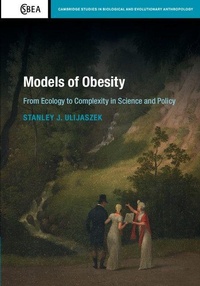
Models of Obesity
From Ecology to Complexity in Science and Policy
Published on 12. October 2017
Book
Hardback
248 pages
978-1-107-11751-8 (ISBN)
Description
Taking a comparative approach, this book investigates the ways in which obesity and its susceptibilities are framed in science and policy and how they might work better. Providing a clear, authoritative voice on the debate, the author builds on early work to engage further in ecological and complexity thinking in obesity. Many of the models that have emerged since obesity became a population-level issue are examined, including the energy balance model, and models used to examine human body fatness from a range of perspectives including evolutionary, anthropological, environmental, and political viewpoints. The book is ideal for those working on, or interested in, obesity science, health policy, health economics, evolutionary medicine, medical sociology, nutrition and public health who want to understand the shifts that have taken place in obesity science, policy, and intervention in the past forty years.
Reviews / Votes
'... it offers potential applications beyond obesity, in the field of public mental health.' Miranda Wolpert, The LancetMore details
Series
Language
English
Place of publication
Cambridge
United Kingdom
Target group
Professional and scholarly
Illustrations
34 Tables, black and white; 11 Halftones, black and white; 43 Line drawings, black and white
Dimensions
Height: 250 mm
Width: 175 mm
Thickness: 18 mm
Weight
617 gr
ISBN-13
978-1-107-11751-8 (9781107117518)
Copyright in bibliographic data and cover images is held by Nielsen Book Services Limited or by the publishers or by their respective licensors: all rights reserved.
Schweitzer Classification
Other editions
Additional editions
E-Book
11/2017
Cambridge University Press
€70.99
Available for download
E-Book
10/2017
Cambridge University Press
€60.49
Available for download
Person
Stanley J. Ulijaszek is Professor of Human Ecology at the University of Oxford and Director of the Unit for Biocultural Variation and Obesity there. He was recently appointed Honorary Professor in Health Research in the Humanities at the University of Copenhagen. His work on nutritional ecology and anthropology has involved fieldwork and research in Papua New Guinea, the Cook Islands and South Asia, while his interests in dietary transitions have led him to examine the evolutionary basis and cultural drivers of obesity.
Content
Acknowledgements and influences; 1. Introduction; 2. Rationalities and models of obesity; 3. Energy balance, genetics and obesogenic environments; 4. Governance through measurement; 5. Inequalities; 6. Food and eating; 7. Global transformations of diet; 8. Obesity science and policy; 9. Complexity; 10. Systems and rationalities; Bibliography; Index.